
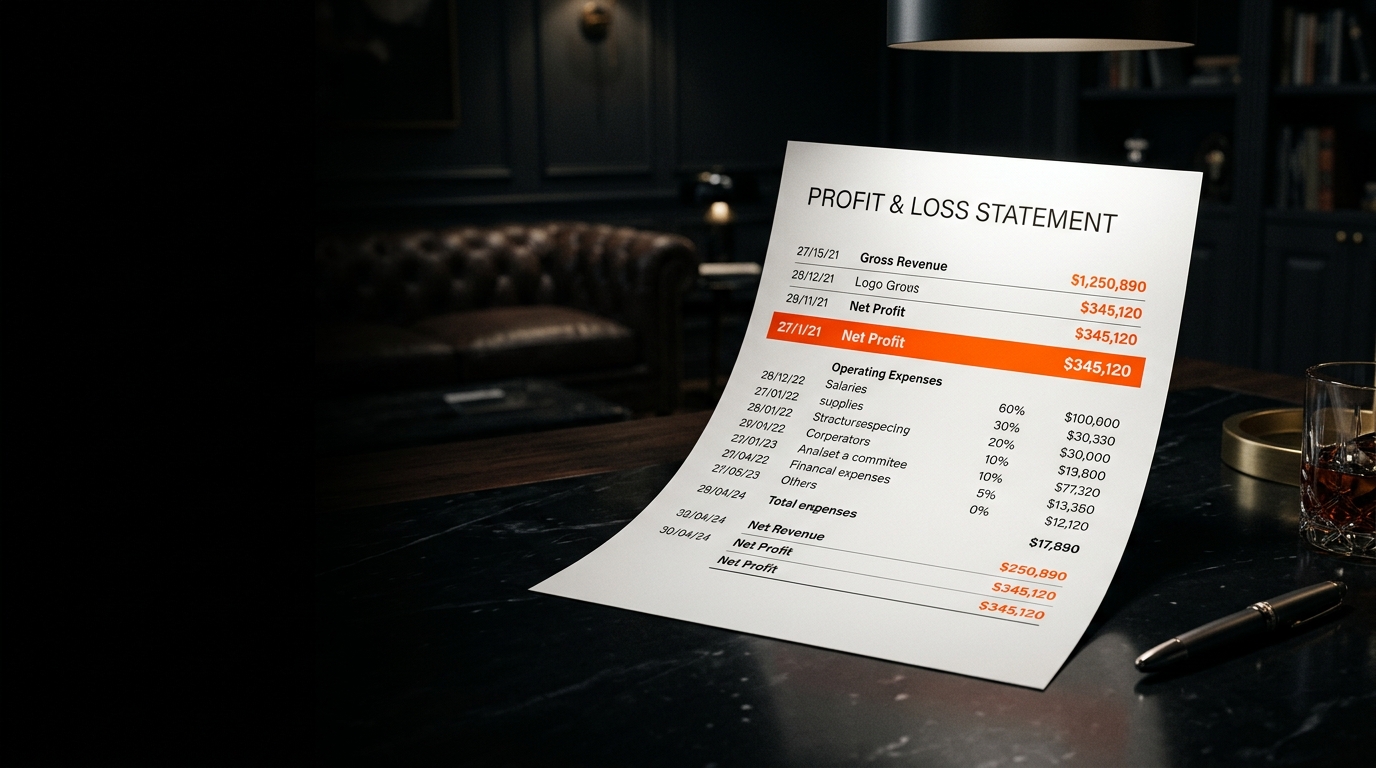
Most dentists have never actually read their own profit and loss statement. They glance at the top line, glance at what’s left, and hope the gap is big enough. Then they wonder why a practice doing $1.5M feels like it’s running on fumes.
Here’s the truth Pete Boulden says on the Bulletproof Dental Practice Podcast over and over: you cannot fix what you refuse to look at. Your dental practice profit and loss statement isn’t accounting homework. It’s the single most honest document about your business — if you know how to read it.
One Bulletproof guest, a growth-minded owner, put it bluntly on a recent episode: his previous accountant “weren’t giving me any P&L statements. So I just had no idea what was going on for the year.” He switched firms, got a clean P&L within a week and a half, and — his words — finally had “a much more accurate view of how much profit we have.”
Read that again. A practice owner producing serious revenue had zero visibility into whether he was making money. That’s not rare. That’s the norm. And it’s why Craig Spodak hammers the same point: “Profit is not negotiable.” You don’t get to the profit by accident after the expenses are paid. You engineer it — line by line.
Forget the 40-line accountant export. A Bulletproof owner reads the P&L as collections minus a handful of controllable buckets. Here’s the anatomy that matters, expressed as a percentage of collections — because dollars lie and percentages don’t:
When Pete talks about margin, he makes a point that reframes everything: “The margins of dentistry done right have enough buffer” that a rate hike or a supply bump becomes “almost a rounding error.” Dentistry has structurally beautiful economics — if you’re actually watching the lines. Most owners aren’t, so a rounding error becomes an emergency.
Because totals hide the leak. A staff line at “a lot of dollars” tells you nothing. A staff line at a percentage of collections tells you everything. The moment you convert every bucket to a percentage, the P&L starts confessing. You’ll instantly see which line drifted three points last quarter — and three points on a $1.5M practice is real money walking out the door.
This is where Randy Smith’s line on the podcast lands like a hammer: “Most commonly, we drive our businesses blind.” He challenged owners to stop treating profit as leftovers. Open a separate account. Pull profit first. Then run the practice on what remains. That’s not a spreadsheet trick — it’s a discipline that forces the P&L to tell the truth every single month.
Quarterly is where practices die slowly. The Bulletproof standard is tighter. As one operator put it on the show: “Daily numbers, weekly numbers.” Craig summarized the whole philosophy in one sentence: “Know your numbers in the daily and react to it.”
The P&L is your monthly instrument panel. Your daily dashboard (production, collections, new patients, open time) is what keeps the monthly P&L from ever surprising you. When you run both, the P&L stops being a report card you’re afraid of and becomes a steering wheel.
The difference isn’t sophistication. It’s the refusal to fly blind. Pete’s discipline: know every controllable line as a percentage, attack the drift, protect the margin. Craig’s heart: profit isn’t greed — it’s the thing that buys you the freedom to build a life, keep your team paid, and never sell your soul to a DSO because you got desperate.
That’s the whole Bulletproof thesis. Clinical excellence is the floor. A P&L you actually understand is how you build the life above it.
You don’t have to figure this out alone — dentistry is lonely enough. The owners who master their numbers didn’t do it in isolation. They did it in a room full of peers who refused to let each other guess.
That room is the Bulletproof Mastermind, where owners share real P&Ls and benchmark against each other — no ego, no hiding. And it’s the stage at the Bulletproof Summit, where the tactical and the inspirational meet once a year. Start with the podcast, then come find your tribe.
The 1% of dentists, who want 100% from life.