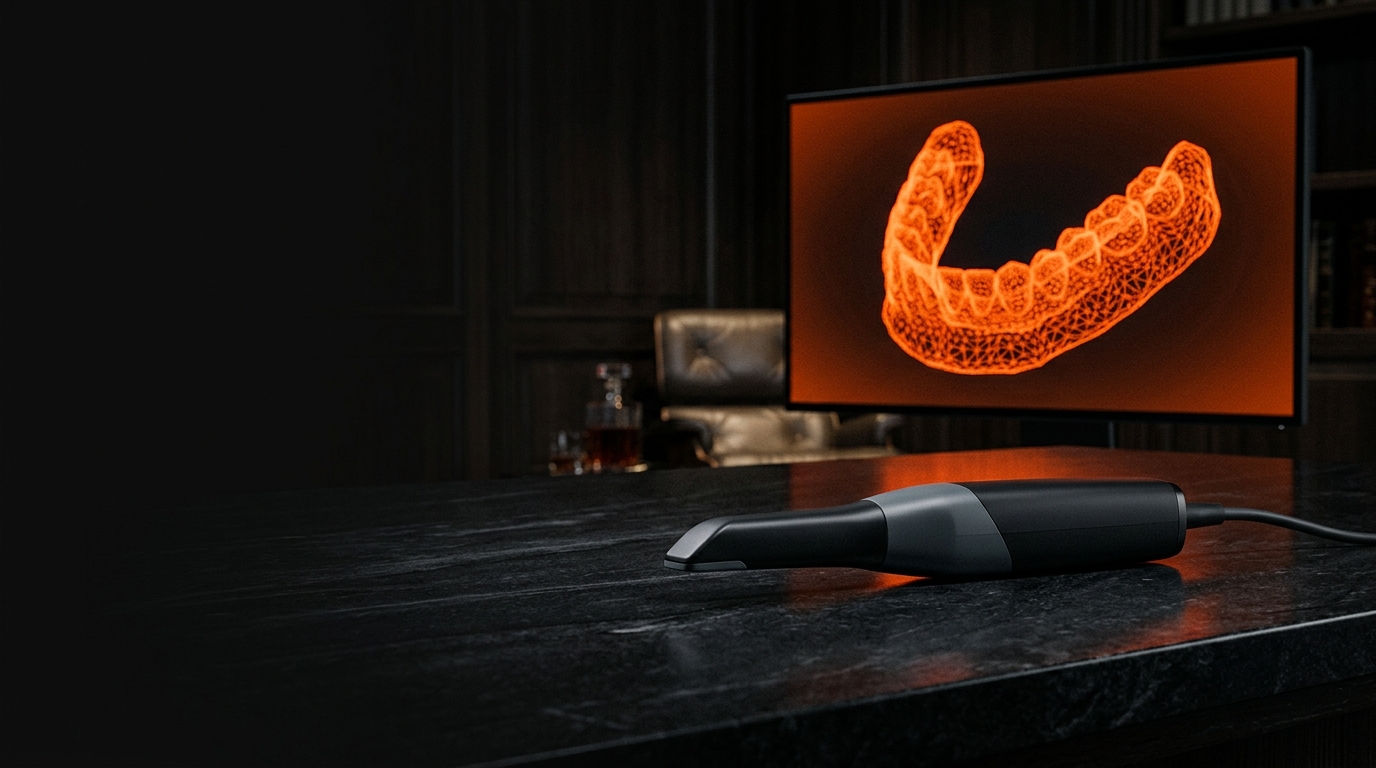
A $30,000 wand does not make you money. What you do with the screen does. That is the entire intraoral scanner ROI conversation in one sentence, and almost every rep pitch skips it. They sell you the hardware. They never sell you the habit that pays for it. On the Bulletproof Dental Practice Podcast, Pete Boulden and Craig Spodak have watched practice owners drop the price of a used car on a scanner and then use it as a very expensive way to take the same impressions they always took. That is how a good machine becomes a bad investment.
Let’s do the math the reps won’t, and then the part that actually matters.
The honest answer: it depends entirely on volume and behavior, not on the brand on the box. But the levers are knowable. A scanner earns its keep in five places:
Run it as a simple model: if a scanner lets you add even one extra crown-equivalent per week and cuts one remake a month, the machine is often paid off inside 12–18 months. That’s not hype. That’s arithmetic — as long as the volume is real.
Here’s the trap Pete hammers on constantly: technology is an amplifier, not a fix. A scanner amplifies whatever you already are. If your systems are tight, it makes you faster and more profitable. If your systems are loose, it just makes your problems arrive in higher resolution.
Craig said something on the podcast that should be printed and taped to every operatory: scanning technology and seeing your prep “occupy a full 16-inch monitor screen is humbling.” He admitted he used to turn the screen away from his assistant when he first went digital, because the magnification exposed every flaw in his margin. Then he flipped it: he made the screen the teacher. That is the difference between a scanner that costs you money and one that transforms your clinical quality.
The technical reality he’s flagged is brutal and worth repeating: an average knife-edge crown prep, taken with a conventional impression, sent to a lab, will often still yield a decent result. That same average prep scanned digitally can yield a worse one — because the technology surfaces the truth of your reduction and margin instead of hiding it in stone. Digital doesn’t lower the clinical bar. It raises it. The dentists who lose money on scanners are the ones who expected the wand to cover for a prep that wasn’t ready.
Less than you think. Two things reframe the number:
The mistake is treating $30K as the decision. The decision is the workflow you’ll build around it.
This is where Pete’s tactical brain and Craig’s culture obsession collide into one playbook:
An intraoral scanner is one of the few pieces of technology in dentistry with a genuinely fast, real payback — for the practice that already runs disciplined systems and is willing to be humbled by its own screen. For everyone else, it’s an expensive mirror. The wand doesn’t make you a better dentist or a more profitable owner. It reveals whether you already were, and hands you the tools to close the gap.
That’s the whole Bulletproof thesis in a nutshell: clinical excellence is the floor, not the ceiling. The technology is only worth what the operator behind it demands of themselves.
This is exactly the kind of buy-or-wait, tech-and-money decision that owners agonize over alone — and shouldn’t. The dentists who get these calls right aren’t smarter. They’re just not making them in isolation. That’s what the room is for. Inside the Bulletproof Mastermind, owners pressure-test six-figure equipment decisions with peers who’ve already made them — and every year at the Bulletproof Summit, that room gets in one place and levels up together. Dentistry is a lonely profession only if you choose to play it alone.
The 1% of dentists, who want 100% from life.