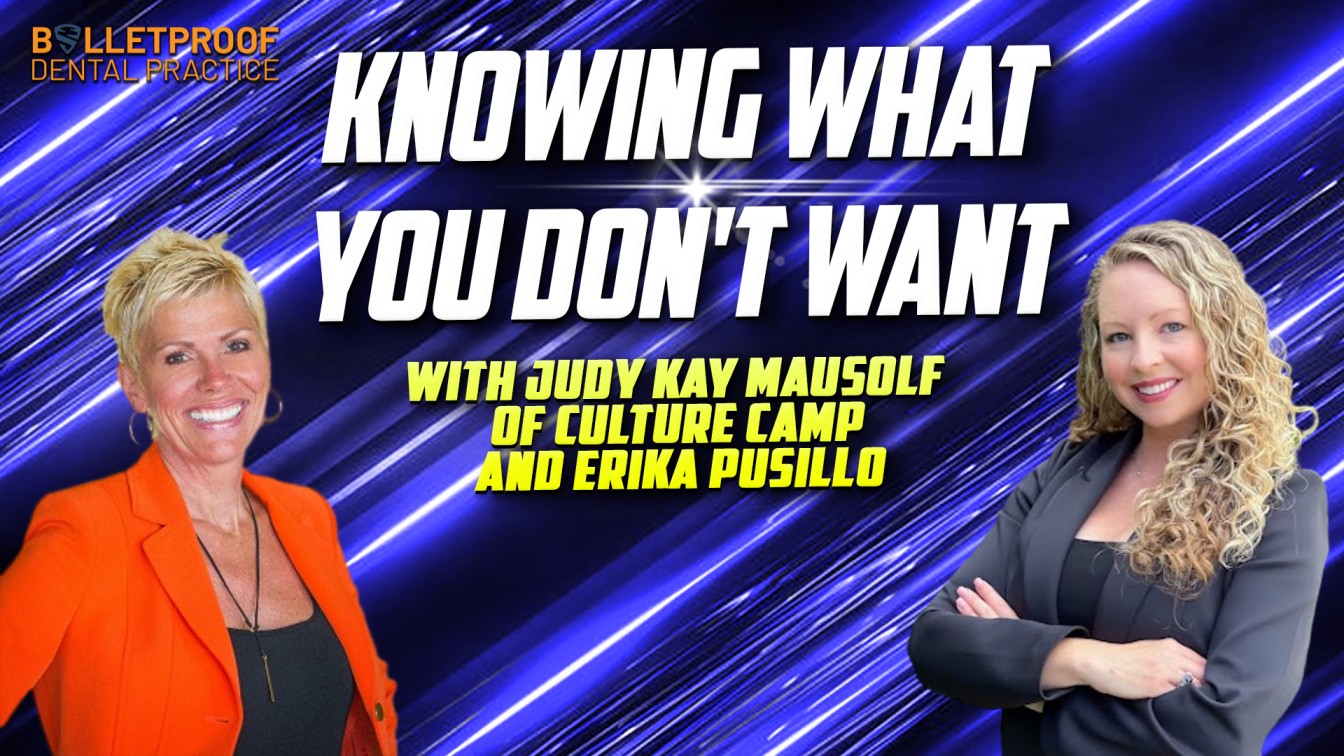
Below is the complete transcript of this episode of the Bulletproof Dental Practice podcast. Prefer to listen? Find us on Apple Podcasts, Spotify, and YouTube.
The following transcription was from the Bulletproof Youtube channel. Here is the https://www.youtube.com/watch?v=rRbOIX3PoH0
Craig Spodak
0:00:00
Welcome everybody to another episode of the Bulletproof Dental Practice Podcast. And since Peter is traveling today, I've got the distinct pleasure of co-hosting with Erika Pesillo. I'm super excited about that.
Erika Pusillo
0:00:23
Yeah, I'm excited for the opportunity too. I always enjoy having our conversations, but now we get to record them live. And I think especially with the topic that we have today, culture with Judy Kay, you all will get to see how we interact live and communicate within our practice because we do the same day out. And then also enjoying Judy's company, who I absolutely love and have seen her speak many times.
Craig Spodak
0:00:50
Yeah, so it's really good to have you, Judy Kay. For those who don't know, Judy Kay Mozoff and Erica and you were hanging at ADOM, right?
Erika Pusillo
0:01:00
Yes.
Craig Spodak
0:01:01
And that's how this all came to be. Tell us the story of how this lovely opportunity was presented to us.
Erika Pusillo
0:01:06
Yeah, well, I'll get started. So I saw Judy for the first time at ADOM while she was speaking in 2016. And when I was there and learned about, can you hear me okay? Yeah. Okay, sorry. And learned about what she did, she's just so inspiring, so positive. I started following her on Facebook, Instagram, and so forth. And she is one of the few people out there that put out positivity in this world, like setting the tone for the day and you know, you have your Motivational quotes you call them Ray for the day, correct? And Yeah, and I I love that. I feel like we don't get enough good vibes out there I think we're just so inundated with what's not going right or the conflict dentistry. Yeah and everywhere I mean, you know, so I so nice. That's how I started following you and I've seen many of your, the videos that you record that you do online and webinars and then the in-person events as well. And I was like, she's a must have to have on the podcast, especially when we talk about culture. It's a buzzword out there. I think a lot of us know culture, but also how we can improve our cultures within our practice, improve our communication with our teams, especially when hiring is so hard. I think right now we're not in a position to let people go as easily as it may have been in the past because there aren't more people to choose from.
Craig Spodak
0:02:40
You need a body count.
Erika Pusillo
0:02:41
Yeah, I think we need to work with the people that we have. So, Judy, if you'd like to say a little bit about yourself and what you do.
Craig Spodak
0:02:49
You've been a great guest listener thus far for Erica's and my podcast, but we'd love to hear from you as well.
Judy Kay Mausolf
0:02:55
I love it. Well, Erica, so you said some things. I took a couple notes because I want to come back to those. Well, it was a pleasure meeting you as well, and I think our friend Ileana introduced us, and you are just a delight and full of energy yourself. So I think it's one thing to say, okay, we're gonna be positive and try to be upbeat, but it has to be authentic as well. And I think that we have to set ourselves up to succeed. You know, you asked me something before we started, Dr. Spodek, about how are we doing for time? And I said, I'm good, I'm good with you. I make sure that I try to lessen any stress in my life to make it more realistic. So many people don't take that into account and they're spinning all the time. So when you're like this, little things become overwhelming. But when you are calm, those little things are very doable. So happiness and positivity, there's actually strategy behind it. You don't just wake up and go, yay, it's all gonna be perfect again today. It doesn't work that way. So I think part of this is helping teams and doctors understand how do we deal with what happens and that life doesn't happen to us, but that stuff is gonna happen forever. So how do we recoup? How do we reset? How do we create a culture that we actually want to work in where we're excited to come to work and create a safe haven so that, because we can't control the rest of the world, but we can control what goes on in our practice, right?
Craig Spodak
0:04:31
Yeah, I like that. I want to jump in on something, Erica, because Erica and I have been together for most of my professional career, and there was a time when I was trying to build a business, and I was the largest practicing dentist of our entire group. And when you don't have any time, so when you have two or three patients deep and Cindy the hygienist needs something from you and there's an HR issue or a culture, you know, something where the team needs you, there's only so fast you can run and it gets to the point where you're putting yourself, you've built a system that's actually working against you. And I tell people that all the time because what you need to do for those dentists who are aspiring to build a larger practice or maybe you want to become an entrepreneurial and again that's not for everybody, but for me, it's what I wanted. I was building a recipe for failure because I was so busy. There was no calm. I love what you just said because it reminds me of something a mentor of mine says. He says, people seek happiness, but really what we're seeking is peace. If you have peace, happiness shows up as a byproduct because if you're seeking happiness, there's a duality there. You can't seek happiness. You can only seek peace. And when you have peace, peace from mind, peace from activity, happiness kind of just shows up. And I love how you started with that. It was very poignant for me and Erica because I was running around like a maniac and she was trying to scale because I couldn't. So I was doing all the dentistry or a lot of the dentistry. I'm like, at least you get out of the chair and then you start scaling. And invariably I'd have assistants come in and these poor, poor girls, I'd be like, leave, get Erica, and have to run and get Erica because Erica's trying to get more operational and more C-suite executive level and I was pulling her back, but I knew at least if I couldn't do it, let her break out.
Erika Pusillo
0:06:15
Yeah, I think that you're just talking about also, it's an energy, and I think that time is going by so much faster for all of us. I feel like we're just like in this like warp speed of information. People want it now. People want it fast, including our team. And especially when you have larger teams, you're stretched super thin. You know, you want to be able to give everybody their piece of time. And it's hard to say no, cause you don't want to come across as unhelpful, especially as a practice leader or an office manager. So Judy, how, what advice would you give for somebody that feels like we're speeding up? And it sounds great to slow down to be able to have that peace, but how do you work it in when life is basically choosing the speed for you?
Craig Spodak
0:07:02
Good question.
Judy Kay Mausolf
0:07:04
Well, I would respectfully disagree that life doesn't choose our speed for us. We still make choices. Okay? So things happen and it's like the frog in the boiling water. Stuff happens, it gets busier and it gets busier. I think for a lot of us, when COVID hit, it was a reset. The rug was pulled out from underneath of us and we had to stop. 2019 was my craziest, busiest year. You slowly get into it, you don't even realize. You do this thing and you do this and then you do this and pretty soon you're spinning so many plates and you don't realize that you're not honoring what you said you wanted to do initially, right? And not unlike you, Dr. Spodek, the busier you get, the more things that have to be done. Well, somebody's got to do it and that somebody is you or that somebody is Erica because you're the ones that were capable of doing it. So you just step up more and more and more. It's really, if you get so busy being busy, you can't step back and make wise decisions All you're doing is putting out fires. So you have to look back. You have to realize that right now Staffing is is a huge issue. I get it And yet it doesn't have to be part of the problem is is we are trying We are trying to accommodate our patients, which is wonderful. I don't disagree with that. However, we have to be mindful that not to the extent of that we don't accommodate our team as well. Our team is, we need each other, or we can't do what we do. And so many practices that I work with, I see that you've got your team members who've been loyal, who've stayed there for years, and who have just been pushing through this, and then they're hiring new people, and the new people don't necessarily stay and they're exhausted and they're still running at that same speed as if they were full staffed.
Judy Kay Mausolf
0:08:57
It's gonna be a burnout,
Judy Kay Mausolf
0:08:58
we're gonna lose our best team members. We have to sit back for a second. It's not just about hiring new team members, it's first of all, how do we make sure we keep the good team members? And I'm going to respectfully disagree again and get rid of the bad team members. Not bad, but the toxic performers, let's put it that way. Those team members who are good at what they do, but they are Godzilla to the team. Because the minute we, because if we wouldn't allow it, and here's the very simple filter or benchmark. If you wouldn't allow that behavior towards a patient, then we should never allow that behavior towards a team member. Because these are our troops, these are our people, this is our tribe, this is what we need to make things happen. And if we truly commit to taking really good care of our team, that I agree with. I think more of the point I was trying to get across is that what's
Erika Pusillo
0:10:09
the intermediate point before you get to that point where you let someone go? And I think that when we talk about practices or people that aren't great with leadership or aren't great coaches, the first automatic is, let me give up on this person before giving them the opportunity to rise to the occasion. I think it's, especially in those times, like you have to be a better leader to have a better team. And I think that if you're not willing to go that route, then yeah, the easy route is getting rid of the toxic person, but maybe the leader is the person that is inspiring the toxicity and that person's responding to it. And so that really is where it's coming from is how do we help this seemingly toxic person maybe first? Like what do we do first in order to get this person? Yeah, we actually have we have a recipe for failure as most of us dentists
Craig Spodak
0:10:57
you know, we're we're taught extensively how to treat teeth and We go through an exhaustive amount of training and at least in my when I went to school a hundred years ago Not one single minute about leadership culture or business systems. So we're thrust out. The first instinct when you're a dentist and you're put into a brand new clinical situation is like, holy shit, I don't know what I'm doing. I better portray confidence. I better not let on. You've worked with new dentists before. It's a scary thing. And now you're expected to be this leader, business owner, so we're just bullshitting our way through it. We don't know. So we're barking orders. We're telling people we're over systematizing over, over, over protocoling people like this is how you answer the phone. This is how you do everything. And what we as dentists need to do is just take a step back like, yes, you're a dentist. You know how to do this stuff, but you don't know what the challenges are with the admin. You don't know what the challenges of the hygienist are. So it's this first, I always say, like in leadership, like we point the finger out, but there's always three fingers pointing back at us. I think what you're getting to, Erika, is we need to grow. You can't have great people if you don't invest in your own leadership. I hope there's just an aha for people to say, because we didn't know what the hell we were doing. We just failed forward, and we kept getting better and better. I'm like, I should take this course. You should read this book. Erika and I were trading back and forth. There's literally thousands and thousands of effort and hours between them. Now it's a symphony, it's magical, but damn, there's a lot of hard work there. And I think it's just this, we need to have a little grace as dentists to say like, hey, I'm excellent at what I know how to do and I don't know how to do what I don't know how to do, and it's okay. So you know, when I meet in the mastermind or bulletproof or whatever, you were there in Cabo last week or two weeks ago in Cabo, Mexico, and it's like, what do I need to do? I'm like, well, what does your team want? Well, I never really asked them. How do I fix these problems? What are the problems? Well, I never asked. So what the hell are you talking about? You never asked anybody. And it's just, it's because we have to come up with the answers. Patients are looking at us on day one. What do I do, doc? And we're like, uh, here's exactly what you do. You know, it's just, so it's like this fake it, you know, and it's really unfortunate because the situation and the institutions and the educational complex of dentistry is broken and not teaching us this stuff. So the average person's listening and it's after burnout and failure. So I think what we're doing, if we can catch those people before they have to fail so hard, like we did, then we have a good thing.
Judy Kay Mausolf
0:13:29
Well, and I think there's some simple things too for starting, you know, when it comes to the new team members first of all, is really being clear about what that position looks like when we're hiring and what the expectations are. Some really busy offices downplay the busyness. And I said, don't do that. Let them know if you like a busy environment, this is the place for you. Because if it's somebody that wants to move at the speed of a turtle and only wants to see one person every hour and a half or two, it's not going to fly. It's never going to work. So don't even go down that path.
Craig Spodak
0:14:00
Yeah, don't sell it. I sell everything, Judy, which is a problem. I'm a good salesperson. So Erica will put the brakes on that. Someone will say, I kind of like a more slow pace. I'm like, yeah, it can be slow here. Erica's like, no, no, no. This is a fast-paced environment. So don't sell it. You got to be fully disclosing what it is.
Judy Kay Mausolf
0:14:20
And then you really have to manage the expectations. Those team members, they haven't worked in your practice. Even if they are trained and they've worked else, it's very different from culture to culture, from office to office, from expectations. And knowing the two of you, I know that you have high expectations, which is a great thing. And you are the top notch in the industry. And so the expectations are here. And that's a great thing. However, we need to manage that new team member coming in so they're not overwhelmed right away either. Those first month or two or three months, they're just like, wow, there's so much stuff here. And if we can be clear about expectations on a weekly, those first three months, with the new team member and the existing team members, because see the existing team members, if this person's working or else, within two weeks, they think they should have it. They're tired of training, they're tired of this, they're tired of that, but if they have clear benchmarks, week one, this is the minimal that this person needs to perform at. And I say minimal because we want to know at week one or week two already, whether this person has the capabilities to work.
Erika Pusillo
0:15:30
Absolutely.
Judy Kay Mausolf
0:15:31
You know? And so oftentimes we do those magical 90 days, which I don't know why we invest a full 90 days. If somebody can't move from week one to week two, and by week three, if they still can't do what they were supposed to be able to do in week one, we've got a problem. And instead of investing 90 days or all this time in with having our existing team working and training, we want to make sure that it's realistic. But it also really adjusts the expectations of the existing team as well, and knowing, look it, this person accomplished this and this yes They can't help me with this over here, but they're there on course They're doing well right and if they learn faster super But we don't want to team members have a tendency to pick the person who learned the fastest at this And then that's where they compare and then there's always this Well, I don't think they're working out or I don't think I should have to do this. And then we wanna pick team members that are actually good trainers as well.
Craig Spodak
0:16:29
Yeah. I think if we paint it with broad brush strokes, I know we're all got our ears down to the ground when it comes to helping Dennis. I think the common idea is I've got the wrong team. I think if you polled the people that are frustrated, you know, an overwhelming majority just believe they have the wrong team and that's not good either.
Erika Pusillo
0:16:50
But I'll say that why is it they believe they have the wrong team? And I think just to Judy's point is they probably didn't have expectations. And I think that we're constantly managing what someone is expecting you to do without them communicating those expectations. They're getting upset and not giving that person the opportunity to actually rise to that occasion. I think that that goes back to like, what is step one? Before we write off this person, are we doing a great job as a leader communicating what we need and how to win?
Craig Spodak
0:17:18
Also, what do they want? You see, like, hey, you're going to be my office manager. Well, I don't like doing that. Well, no, you've been here the longest. You get to do it. Then there's no communication. So it's like when we interact with these people, it's almost like an intervention. Like, I thought you liked Italian food. No, I absolutely hate it, but I take you there for your birthday every single time. So it's a failure on multiple levels. But when you believe you have the wrong team, like mindset is very important in my world. Like if you really believe that, if you believe your entire team is wrong, it's really hard to work and take positive steps forward if you have that belief. So you have to get a little curious. I think the first step is like, okay, maybe I didn't do the right job of explaining exactly what I want. And then even apologizing, getting your team together. Hey guys, I never went to leadership school here. Let's have a meeting. What are the five, even the things we've done, like sending out double-blind surveys. What are the five things I should never do again? What are the five things I should always keep doing? And just getting more understanding of how you are being as a leader in the office and where people need help. And I don't think, I think these are like dysfunctional relationships that just turn into those bad marriages where they're like the dining dead, no one just talks anymore. And you get some culture expert coming over, not you Judy, but the others that are in the industry and say, let's have a happy hour. And you just stuff all that crap in the drawer and everybody just gets drunk and somehow they think it's better, but it's not.
Judy Kay Mausolf
0:18:39
No, no, it usually ends up in a bigger battle. Yeah, and that's really what I design my culture camps around. It's really about helping people have an open conversation and kind of taking the temperature of where we are right now and where do we want to go and who's actually still on board with going there and doctor first of all you tell me where it is you want to go and then I'll help you communicate that for starters and then get people help align. Judy a question for you sorry let me let me just interrupt you
Craig Spodak
0:19:10
when you ask the doctor tell me where it is you want to go. Is that usually like when you have people that are like, you know, in meltdown mode, they're calling you and things aren't going well. Is it oftentimes hard for the doctor to explain where he or she wants to go? Is that like a root cause of it?
Judy Kay Mausolf
0:19:29
Yeah, but yes. I would tell you though what I normally do is it depends. And I get very different places of where doctors are at. Some are always wanting to be up here, so they want to keep everything fine tuned. And some are struggling with the Hail Mary, I think I'm gonna lose my whole team. So it's a vast difference. So a lot of times what I'll ask them, and that was kind of just a short surface statement that I made, I will say, what's important to you? If you come in, you open the door in the morning, you come into your practice, how do you want to feel? What's important to you when you come to work? What are some core values that you would use to describe what you want to exist in your culture every day? And let's build around that. And that's a starter. So that helps them understand and at least have something, some framework to build off of.
Craig Spodak
0:20:28
What percentage is the both? What are the people that are like the high achievers that wanna fine tune it versus the hail Mary, let me just call, you know, do the culture camp. Like what percentage is it between the two?
Judy Kay Mausolf
0:20:41
I'm probably for, and I can only speak for myself.
Craig Spodak
0:20:44
Oh no, just you specifically.
Judy Kay Mausolf
0:20:46
Clients that I work with, I would say I'm pretty close to 50-50 or maybe even 60-40. I have the privilege of speaking often in different venues and I think people are excited to hear that and some are fearful, they don't wanna lose what they have. So they wanna make sure that they keep a healthy environment. And I think in some people, I mean, we all continue to grow and learn, right? And they hear something and they're like, well, we could do this and this and that would make it even better. And then you have the others that are – and then truthfully, I think I don't ever hit the bottom. I don't think they ever even realize they're doing anything wrong.
Erika Pusillo
0:21:25
I would also like to know, you know, I have a presumption that for the doctors that want to keep things fine-tuning, they understand what they want to see or what values they possess or where they want to go, what vision they have versus maybe the ones that might not know what their culture is or may not realize that they're getting ready to lose their team. And do they even know what it is they want? Because back to the conversation about having those clear expectations, if the leader doesn't know where the practice is going or what they want, it's really hard for the team to get behind it. And so there's got to be a correlation between the two. It's like the less clear you are as a leader and where you wanna go, I think the harder it is to build a strong culture because the culture is gonna go into so many different avenues.
Judy Kay Mausolf
0:22:15
You have to have clarity, you have, and it can't be a million things for everybody. So I actually just start out with four core value words and I work with them and ask them questions. And sometimes those that are struggling more may struggle a little bit. Some of them are actually very clear about they know what they don't want anymore, right? And that helps to clarify it. And it may not even be the word they're looking for. They can just describe what's happening, what they don't want to see anymore. And you can fill in the blank a lot of times and say, well, so would that mean something like, would this be a good, you know, caring or whatever, you know, be something that you would strive for then. And that helps them to clarify. And I think that, you know, it may graduate, it may change over time, but most of them are pretty clear about what they absolutely don't want to have anymore.
Craig Spodak
0:23:08
That's clarity, though, just knowing what you don't like.
Craig Spodak
0:23:11
That's exciting.
Craig Spodak
0:23:12
That's a great start. If you don't know what you want, at least being able to find what you don't want. And I do think the dental profession, we're also not doing a good job of understanding that each practice is a snowflake. And there's so many different business models. You have the privilege like we do to go into so many different practices. In fact, two weeks ago, we saw five different practices in one day in Houston, and each one was like a different industry. A hundred percent. So it's like saying, let's go check out a bunch of restaurants showing up at a Chick-fil-A and a Morton's and a blah, blah, blah. And I think from the inexperienced dentist view, because we all live in our own ecosystems, we think a dental practice is a dental practice. You know, I've got a couple of chairs and you've got these admin people and you've got a hygienist. Like, what's so different? Why do I need to have a vision? Like, you know, what are you talking about? And it's really unfair because every dental practice is so incredibly unique based on the psychology skills of the leader and the team. It's almost like a soup. I talk to Erica that every time we bring on a different person, our goal is not for them to absorb all of our culture but for us to absorb them as well. It's kind of like a big soup. You add garlic to it. I want the whole thing to be different. If I could, I wrote a vision statement back in 2008 when it was just maybe two or three three employees here in a very small disorganized operation with just my mom and my dad. I wrote a very explicit vision of what I wanted to see as a descriptive vision, like how people felt, how I felt about how they felt. It was all emotive. It wasn't like, I do 9 million a year and 16 operatories and blah, blah, blah, or 18 operatories, whatever. It was like, how did I feel being in here? Most importantly, how did other people feel and how did that make me feel? And now when I look around, I'm like, it's exactly what I wanted. Exactly. Like I just, I don't see patients on a daily basis and I probably annoy the shit out of people because I just want to hang out with everybody because I love everyone. But it was very intentional and I think that that was hard to do. And it took, especially for a person like me, who's probably a little bit ADD to sit down with pen and paper, it was torture. But it was a roadmap that I was able to execute. And had I not done that, I would have woken up at 50 or 51 like I am now, really unfulfilled. And I think it's important for the docs and the team that are listening to this to understand you have to sit down and get very intentional. Dentistry is not one size fits all. It's a very unique business. And what patient avatar you're looking for, what type of team. I mean there's certain people that would work at McDonald's and not work at Chick-fil-A and vice versa. Right. They're both minimum wage fast food jobs.
Judy Kay Mausolf
0:25:47
Right, but it's different. It's a different culture and that's one of the things I try to show in a presentation that I'll ask volunteers from the audience to come up with four core value words and to write them down. Then I'll go around the room and I'll say, okay, so there's four over here. Like one might be friendly and excellence and caring and high technology, who knows? You know, and another one's something legacy and trustworthy and excellence and something else. And there's like a little nuance. And then you keep going. If you go to about 10 or 12 different people, it very clearly defines that, look, there's a different energy in each of these offices. There's a different why behind why the owner doctors are doing this. And that's what we want to tap into. We don't want you to become something that you're not. We want something that's innate, that you want to be, that you want to bring out. That is your strength. That is important to you. You know, I think back when I started my business I was administrator for 25 years before I got into this and what a dentistry dentistry. Yeah first ten years general final 16 Was period
Craig Spodak
0:27:03
Okay, so like we office manager like tell me what your office administrator. Okay, cool How many tell me what the last job was like how many doctors how many team for doctors 2018 members okay you were the the chief of the whole thing like the highest level administrative person
Judy Kay Mausolf
0:27:21
my doctors came in there was an owner doctor and three associates and the owner doctor said this is yours I'm going to do dentistry I drug him into the conversation a lot more we actually co-led a lot he was very good to work with. When I decided to start my business, I remember my husband Steve saying, he goes, Jude, what's important to you? And he said, what do you want to do? And I said, I just want to help people have a better life. And I said, I'm going to use dentistry as the vehicle to do that. And so that's always been the why behind it. And I think when you can help dentists, and because everything starts with leadership. It's either what they do or what they allow that comes into their culture. Because they're the only ones that can change. If they don't want that, you know, if you have a toxic team member, they're the only one who makes that final decision. Yes, your office administrator, whatever, director of ops may, but it still has to be finally approved or agreed upon by the owner doctor. So it really is the more we help the doctors understand and are clear, and I'm speaking to the people who know this well, is that once they're clear, and then we have to teach them how to communicate that in a way that their team is on board so that their team knows because there's nothing worse than today we're doing this, and then tomorrow we're going to go this way. And then because they don't feel like they understand
Erika Pusillo
0:28:58
what the purpose is behind it then. Sure, no consistency. So what I'm hearing in summation is that really culture, the foundation of building a good culture comes from vision, clarity around what you want to do, where you want to go, and making sure that your team team understands that very clearly. And even bringing on new people that may have had one position in a different office, they may have different responsibilities within yours. And so even for an office manager, one practice that you bring into your new practice, you will set them up for failure if you're not clearly communicating your expectations within yours. And I think that's really important also for our team to have a great experience. I mean, that's kind of one of our whys. It's like we focus so much on providing a great experience for our patients that sometimes we forget about providing a great experience for our team. And that's what this is about. And, you know, we want to come into an environment where we're supported, where we feel like we can win. And when we know how to win, we can make better decisions. And I loved how you said, you know, it's It's either defining what you do or what you allow Yeah, and I liked how you use that word because I think a lot of times we hear doctors Well, they'll say, you know I have these team members but you know they always come to me for the decision or they always come to me with all the problems and I have to be the person behind every single decision we do even the simple ones. And I think it also comes back around to, well, were you clear in what your expectations were? Were you a good leader? Were you a good coach? And I just loved how you had that definition between the two. It just really resonated with me. What do you allow?
Craig Spodak
0:30:40
Also, with the what you allow conversation, too, it's like I could describe this beautiful chocolate cake I wanted to eat, and I really didn't understand the recipe. So in life, it's beautiful when you understand your unique God-given strengths and you partner with people like I have with Erica and numerous others where it's like, I need her to get this done. I can describe a chocolate cake that she actually likes too, but she knows how many eggs and the sugar and blah, blah, blah. And when we say what we allow, we lost a lot of time. I mean, I don't ever look at it like we lost time because it's all been fun and learning and getting your ass kicked is part of the process, but allowing people too long. So Erica would oftentimes say, this person is going to cost us a lot of money. This person's going to be a problem. Let's kind of like, let's cut the head off the dragon while it's small. And I was just like, no, no, no, no, no. Now I'll change this person, I'll blah, blah, blah. Because I am good at that. But you're good at changing people when they're open to changing and they want what you want. There was this presumption like, oh no, they want chocolate cake too. And Eric was like, no, no, no, they're going to blow the whole place up. And invariably, they did blow it up and we had to get rid of them, but we could have chopped those, we could have killed the dragon while they're small and you'll meet bad people. And when I say bad people, they're just not a good fit for what you want to create. They're not bad as in good and bad human beings. They're just not right for you. And for me, I'm a connector. I like to connect with everybody. And we would have been so much further ahead, number one, knowing what I'm good at and what I'm not good at and explicitly defining that and knowing what she's great at and what she's not great at and just really doubling in our strengths and covering each other's weaknesses. And I think that we just assume that everybody's the same and they're not. And if you have those bad players, you can't allow them. If it was up to me, all those bad people would probably still be here ruining us. But Erica wouldn't allow it. She at a certain point, she got to the point where she's like, I've seen this movie before and we're not going to go through the bad ending. I'm like, okay. And I'm like, then you handle it. She handles it with grace. They hug her on the way out usually, or sometimes I tell her, pick out your shovel because I'm going to bury you like the one that we had. Allowing people, the wrong people, you're actually damaging your culture. I think dentists get in trouble because they conflate the business with themselves. As a business owner, your business is a little baby and it needs to be taken care of outside of your own personal needs. The doctor out there that's making the money that they want but your team is miserable because you have a toxic person, and that toxic person kisses your butt because you're the owner, but then is ruinous to everybody else, you have to do the hard thing to protect your team. And they'll value you for that.
Judy Kay Mausolf
0:33:30
And you said something about good at changing. It really depends, like you said, the person has to be open to change. And I couldn't help but smile. I think at ADAM this last year, they had me speak five different times. So it was like when I said, Kim, use me as much as you want, she definitely did. But every audience I had, I would get managers that had been in the industry for many, many years, and very good. And here's the line, but Judy Kay, but Judy Kay, you don't get it, but Judy Kay. And I said, I know there's this one person and I said you don't have to go any further. I said here It's really very simple. You create a culture you make agreements as a team how we're going to communicate how we're going to work together We're all in this together. We're all pieces. You just call it soup. I call it pieces of a puzzle, right? We make agreements on how we support each other We make agreements on how we're going to enter in the morning and the and we're going to be mindful the energy we bring to each other. That's a responsibility of us. It's not my job or the manager's job to make people play well with you. It's your job to be easy to work with. It's your job to make sure you're being respectful of each other, right? You can only control what you do. You worry about what you do. So you start having these conversations and then there's this person who's always skirting the issue, always doing the things. It's a very simple conversation. Look, Susie, you're phenomenal at what you do. However, here are the agreements that we've made as a team. Is this something you're willing to support? We hope you say yes. If not, then we wish you well.
Craig Spodak
0:35:03
Great distinction. Yeah. And especially attached to their personal progress because some people just want to stay stuck and it's just up to you to release that.
Judy Kay Mausolf
0:35:11
And they're not bad people they have their own agenda, right? They they've decided they like vanilla and you like chocolates no big deal They're both great ice creams, but they want your practice to be vanilla and right your practice to be chocolate. Yeah
Craig Spodak
0:35:25
Yeah, everybody else wants chocolate. Yeah, it's it is hard though when you when you look at that, but It's the intoxicating thing I just want to add one thing here to kind of just take it in another direction is the intoxicating thing is that when you are good at affecting change and you have someone that's not a great player, but over time you grow them into a great player and it's like, damn, I could change everybody. We have so many examples of that. We have two that are coming to mind and they may have listened to this so I can't think of it right now. I'm sorry, I can't mention it right now, but we have two people that one was never really happy at work, you know, kind of like FML, it's Monday, you know, I hate Mondays. And now I just talked to her and she's like, look, I would be miserable if I didn't have work and purpose. And another one had left the office or the organization for four or five years and came back and is actually doing better now. And it.
Erika Pusillo
0:36:20
Sorry, I'm like raising the hand here, too, because also throughout this process, I think that when you're saying, you know, other people are growing, which they are, but we grew. And so I think if we look back at it to say, we're actually better at providing clarity and direction and expectations, which then allows this person the opportunity to be better.
Craig Spodak
0:36:42
Yeah, Erica will take the pie in the sky ideas and boil them down like, here's the five steps to win. Here's how you can be successful every day, and I'll be on fast-paced and low detail So it's just like hey come check come follow me. It'll be it'll be great
Judy Kay Mausolf
0:36:56
Well and and and that's you know when you when you look at this as far as them learning and changing and and over the years I've met some people that have really like switches changed, you know and you said the powerful words at the beginning, your mindset. It's amazing how much power our mind has and people don't realize it often. When we shift, the only difference between something being stressful or not stressful is our thought process on it. It's funny, if you have a Saturday and you have all the time in the world to do something, you're not stressed about it. But if you're doing it during the middle of the week and you thought it should have been done at nine and it's now 9.20, you're stressed, right? So it's always that mind shift. And some of these people, all of a sudden, something changed in their life where they decided, you know what, I actually want to be here and I really want to make this work. And then you see this where they're coachable. Because a lot of people, when they're resistant, they're not coachable. They're not open to hearing it.
Craig Spodak
0:38:08
Sorry, go ahead.
Judy Kay Mausolf
0:38:09
Well, I think of one person in particular that, amazes me what I see when I go into work with offices. I walk in in the morning, that first day and she's at the back door and I'm walking in with the doctor and she's literally glaring at me. I'm thinking, well, that's probably not a great way to start out our connection but she's glaring at me and the doctor induces us and I say good morning she's like yeah and she walks away so later I'm talking to her and she's I've had those people. Extremely talented at what she's doing but she's just a monster she's toxic so I pull her aside later in the day and I'm chatting with her and I said, I just have one question for you. She goes, oh, here's some rah-rah stuff. And I said, oh, no, I have no rah-rah for you. You passed the point of rah-rah.
Craig Spodak
0:38:57
Why do you want to sabotage your success?
Judy Kay Mausolf
0:39:00
I said, what are you afraid of? And she's like, well, what do you mean? And I said, why are you so afraid to be good at what you do? Why are you intentionally sabotaging that?" And she was really quiet and I said, you know, take the night, think about it. And I said, if you're going to come back tomorrow with the same attitude, don't even come to the culture camp. I said, it'll be a distraction. Don't waste your time and more importantly our time. And I said, but if you have a change at heart, I said, we'd love to see you and we'd like to start fresh. Line in the sand day. So the next morning she came and she said and this is the hard part in life, she said you know no one's ever told me that I'd ever be worth anything. No one's ever believed that I had the capability. Everybody's always told me I was going to be a failure so she said if I sabotage it myself then I couldn't blame it, I couldn't say it was me really. I could say I chose that, so it wouldn't hurt as bad.
Erika Pusillo
0:40:06
Yeah, it's funny because, well, that part's not funny, but I hear it so often where you have people that just have low self-worth, or they're just looking for that external validation, and that when they don't get it through the process, they just end up becoming the very thing
Erika Pusillo
0:40:24
that they didn't want to,
Erika Pusillo
0:40:25
or that other people were saying that they were going to be. And it is interesting, you know, we do have the choice to create our own destiny and some of the advice that I give to my team members is that, you know, you have the decision to take your life into whatever direction that you want it to be. Like, don't let anyone else determine your destiny or what your success looks like, you know, at any cost. And if you're having trouble knowing what that looks like or how to get there, you've got many resources. But ultimately you're the one deciding every single step of the way. And I think that what you also did with that comment with that team member is that you're turning the mirror back on them. And Dr. Craig will say that all the time is that you show them themselves, have them discover that they are at the root cause. Because what we've also seen is that we have other team members or have had team members that have left and gone to other places that supposedly grass is greener. You can't escape yourself. And so what they realized is that they actually brought the problem with them and it didn't really resolve anything at all. And so I think it's an interesting perspective. It's like, you know, culture starts with knowing where you want to go, communicating that well, and also leading yourself. You have to lead yourself first.
Craig Spodak
0:41:44
Judy, you did something very subtle, but it's very important for people to unpack. And I want to just, you said something very important. You can't influence somebody when you're also judging them. So when we judge this person, she sucks, she's always showing up in a miserable mood, and blah, blah, blah, you can't, you have no power over them. So you said something, it was very small, but I'm a word guy. You said, tomorrow is a blank slate. Tomorrow is a blank slate. We're starting fresh. Tomorrow is the first day of whatever you want to create. And what you did in that moment is like, hey, I'm suspending judgment. I don't know you. I know you snarled at me today and I know you're being a wet mop or whatever with your energy, but tomorrow is a new day. So one of the things that I think has been very powerful for both Erica and I is like when Erica goes in a meeting and she's like, oh, you know, because we all have these things. We're all human. We're like, yeah, she's late, blah, blah, blah. This person's what, and I'm like, listen, if you're going to have any power on this person, suspend your judgment. You have to release what you know about them because it takes two to tango. And this woman who you turned around, all you did was like, hey, I'm new. Tomorrow could be a new day. And each one of us, we're new every day and we're sometimes monsters on a Wednesday and getting better by Thursday. But as a human experience to constantly be evolving, what the problem is is we stack all this crap on ourselves and other people stack it on us. Sometimes you need to shift an environment just so you have that opportunity which you gave that woman. You started her fresh in her own space. And I think it's just important, release judgment. If you really want to influence people, you must release it. Eric always says to me, people feel what you believe. So if you're using really nice words, but you're like, this person's such a piece of crap. Oh God, they're so freaking lazy. Bubble up, that's your dialogue about them. You're never gonna be able to help them.
Erika Pusillo
0:43:34
Oh yeah, well, you can sense.
Craig Spodak
0:43:35
You feel it.
Craig Spodak
0:43:36
The energy's there.
Craig Spodak
0:43:37
Yeah, your words are good, but your energy's like, you suck, you suck, let me hear it.
Judy Kay Mausolf
0:43:41
And that's the thing, it's when we're working with somebody, I think so often times we get to their toxic person before we've even had any conversations.
Craig Spodak
0:43:50
Well, the doctor pre-programs you, Judy, watch out for Becky, she's a monster. And then you have to, okay, well Doc, what makes her a monster? Blah, blah, blah, why is she still here? And then you get to see that Becky's probably not a monster. It's that Doc has been really harsh on her sometimes. Maybe Becky could be a monster, I'm just saying. But oftentimes, it's that they're been labeled and judged.
Judy Kay Mausolf
0:44:13
A lot of times, it's misunderstandings, it's assumptions. And let's be honest, there's certain people we click with easier than others. That's a problem too, by the way, Judy.
Craig Spodak
0:44:22
That's a huge problem.
Craig Spodak
0:44:23
We like to hire people like ourselves. If I hired a bunch of people like me, this organization would be gone quick. You have great ideas, but it would sink with awesome ideas. So it's really important not to hire who you like and who is like you, but who complements you. Find out where you're weak and hire that person.
Judy Kay Mausolf
0:44:44
That's one of the things we do, too. I focus on the culture camps because that's my experience. That's the capacity of how I work with teams instead of long-term coaching. And one of the things we do is we talk about people have a tendency to really like personality testing and all of that. And I will say that I'm oftentimes not a fan because people will pick up and label themselves. Oh, I'm a D or I'm an I or I'm this and this is just how I behave. And they use it as more of a weapon or an excuse, and as I say, labels are an excuse to continue the behavior, than they do to really make a difference. things we talk about is the strengths of this person taken to excess are the things that drive you bonkers, right? You know, and I use my husband as an example a lot. He loves it. He's used to it. But he has all the time in the world for me. He will take time to do whatever, but that means he also runs behind a lot, right? So there's that ebb and flow. You know, for me, I'm gonna get it done yesterday. Let's make this happen. But sometimes I'm not going to stop and smell
Craig Spodak
0:46:07
the flowers and
Judy Kay Mausolf
0:46:08
So there's that balance and when we balance each other out and that's where I'll say to the team I said look this is the perfect person for you right here because they excel at this and You excel at that and it's just like those pieces of the puzzles going together where it's it's a perfect fit. So I think the big thing is we don't, I'm sorry, it's just that we don't spend the time talking about and actually having a conversation. Instead we want to label somebody and say, well, this is what they need versus just saying, Erica, tell me what's important to you. What can I do to make our relationship better or easier for you to work with me?
Erika Pusillo
0:46:44
That would be my conversation. I love that, especially as like a first start. You know, this morning I had a conversation with one of our team members that was having a tough time learning how to mend a relationship. A doctor no less, right?
Craig Spodak
0:47:02
Yeah.
Erika Pusillo
0:47:03
And part of that is that sometimes we have those expectations and that when we expect people to think like us and act like us, that there's an upset when they don't. We have to let that go in order to move forward. At some point, someone has to be the one to take the initiative. But I think that with the labels and something that we've done in our organization pretty well is that we don't have labels for specific things. We keep them pretty generic. Even when it comes to, let's say the label of office manager, it isn't the same office to office. And so when you box them in or you have that label, you are setting up that person for failure because it can be different. And, you know, judgments, you also have the personality tests, like you had mentioned before, that, yeah, sometimes people fixate on that label or that word. And then they do, they use it to their advantage or disadvantage, and it is unfair. I think it's just, it's information, it's context to the whole, it's one small piece. If you can navigate using it as one small piece of the whole. Right, right.
Judy Kay Mausolf
0:48:19
Yeah, and I think that that's so key, you know, when I think about the people and their personalities and how they're working through it, so many times they don't take the time or they just want a quick, let's just make this quick exchange
Judy Kay Mausolf
0:48:37
and move on.
Craig Spodak
0:48:38
I was saying with you, what are the four steps to creating iconic culture? Oh my God.
Erika Pusillo
0:48:43
I thought we were going to talk about that today.
Craig Spodak
0:48:45
Do we have to go through the whole culture camp? Come on, Judy, you know it's not that hard. It's just one of the, is it just cookies? Like I was on an AACD podcast the other day, and I probably won't ever be invited back because they talked to me about leadership. I'm like, hey, what are the things that you can do to improve culture? Like one of our members said, like, bring a dog to work. I was like, okay, so if you have crappy culture, now you have a dog in your office. Now you have crappy culture plus dog shit. That doesn't help, you know? Like, it's not cookies and dogs. It's really hard and Fortunately, you know, it's hard girls. Everybody could do it masterfully
Erika Pusillo
0:49:22
Well, but those steps are the frustrating question relationships are are what's challenging actually not to bring it back to the conversation We had this morning, but these tactical trans transactional things is What's missing the point is that you're not? Connecting as a human being on that emotional level and just getting down to it The root cause is it's like we just need to know that we're supported that people care and that we are existing moving towards a common goal, you know, and and that's the relationship part is the hard part.
Craig Spodak
0:50:05
And it's compounded in our practice because in our practice, if you're a doctor, it doesn't entitle you to boss the people around. So you come from other practices and it doesn't matter what the doctor says, you go get the masks right now. And in our practice, that doesn't fly. So she's actually a shining, she's sticking out like a sore thumb because she came from other practice like, well, I'm the doctor, I'm supposed to tell you what to do. So when the leaders like you and me never demand things from people, it makes her, she has to massage her leadership even more. She's in the leadership NBA now. And I think it's incumbent upon those associates and doctors that work there, like, you are the highest person up there, but you need to be excellent in your leadership. Your position does not entitle you to be respected. And if you want to hold a gun to people and you are the boss and you want to use the gun on people, you're going to have a very low level of culture if people are just scared of you and doing it because you hold the gun. That's not real leadership.
Judy Kay Mausolf
0:51:01
Yeah, and wait until they take the gun away from you, right? Yeah. And it's so true. So when people start playing games, they go, well, what about this, Judy Kaye? Can I do this? I just look at them and I just laugh and I say, so would that be a healthy adult relationship? Because this is really about we're working together. There's if there's two of us working together right now There's three of us What do we need to make this successful if you don't want to be a part of helping make it successful then go somewhere else Where you do want to be a part of that, but in the meantime? We have to respect each other and and and treat each other with kindness and help support each other. That's really, you don't have to love me, I don't have to love you, we don't have to agree with everything you do outside of the office, you know? And so many things, you know, doctors will go, well, should I address this? And I said, well, do you consider that's a healthy adult relationship? Well, no, and how about throwing instruments? Is that a healthy adult relationship?
Craig Spodak
0:51:58
Can I do that at least, Judy? Don't take that away from me, I love throwing my instruments.
Craig Spodak
0:52:02
Definitely more kinetic.
Craig Spodak
0:52:04
Yeah, can I spray the water like Jennifer Aniston did in that, what was that movie where she was sexually harassing her male? Yeah, she sprayed the water on him like, oh look, I got you all wet.
Craig Spodak
0:52:14
Yeah.
Craig Spodak
0:52:15
It's toxic.
Judy Kay Mausolf
0:52:16
We play a lot of games and that's the hard part. When it comes to the soft skills, which are really the hard skills to do, to accomplish, we say, well, it wasn't really clear, it wasn't really written down, it wasn't really this. And it really boils down to when we step across that threshold, we're changing the culture. What we bring in as an individual changes that culture immediately. It's what we do or don't do, it's everything about it. You can't enter that, you're breathing the same air, you're exhaling in there. It's all connected. So I think that that's one of the things that I work really hard with the teams is helping them understand their ownership and the doctors helping them understand their ownership in what they do or don't do to help create good relationships. And truthfully, you guys, the most important thing in our life is our relationships. That's where our happiness comes from.
Craig Spodak
0:53:11
Hey man, it's so true. I applaud you for what you're doing because as an industry, when you look at the 30,000 foot view, we're really not doing very well, unfortunately. I find myself on Facebook groups that are 30,000, 40,000 members and the caustic, toxic comments about these effing hygienists, and these office managers, and there's so much division. We're all on the same team, but yet it's front versus back, and doctor versus hygienist. I just want to shake everybody up, so I applaud you for what you're doing because we need like 20 more of you. You're a drop in an ocean of broken culture and psychology, and it's such a beautiful thing. We get paid to help people, and everybody plays a very important role, whether you're on the phones at the front or sterilization or the clinicians. It's really noble and great that we get paid to help people, and it's broken. People at Chick-fil-A are probably happier than the average dental person, and they're selling a sandwich that's arguably very bad for you. What we sell is good for people. We help people. And it's broken, so I applaud you for what you're doing. And I'm glad that this message is getting out to people. I hope it spreads for the sake of our profession.
Judy Kay Mausolf
0:54:40
Well, all we can do is try to help one step, one practice at a time, right?
Craig Spodak
0:54:45
So, Judy, I want to be respectful of your time. How do we get in touch with Judy Kay of Culture Camp? Like what's the, can we put a website at the show notes or something like that for you?
Judy Kay Mausolf
0:54:54
Yeah, that would be, yeah, it's practice solutions inc.net. Okay. And solutions is plural. So, and there's just a little box there. They can type in ask Judy Kay. And just fill that out and you know, put your name or your question and I'll respond to you.
Craig Spodak
0:55:12
Okay, sweaty back moment.
Craig Spodak
0:55:13
I'm gonna put you on the spot. Is there any chance that you would do something kind for our listeners? Can you do something special for them if they say they came from Bulletproof for you?
Judy Kay Mausolf
0:55:23
Sure, sure. So I have three books. If somebody wants a complimentary book, I'll send them a book.
Craig Spodak
0:55:29
Sweet, that's all I needed. I just wanna feel special. You made our listeners feel special.
Judy Kay Mausolf
0:55:35
It'll help lessen the boxes I have to move. Yeah, I get the feeling.
Erika Pusillo
0:55:38
We've got to book two.
Craig Spodak
0:55:39
It's a win-win. Yeah, it's awesome.
Judy Kay Mausolf
0:55:41
Well, Judy, we really appreciate it.
Craig Spodak
0:55:42
A special thanks to Erica for making this all happen because she was the one who was like, we've got to get her on the podcast. I appreciate you making this happen. I appreciate you being generous with your time and helping lift our profession. It's a noble endeavor and I appreciate you. Absolutely.
Erika Pusillo
0:56:00
Thanks, Judy. I appreciate you. I appreciate you.
Judy Kay Mausolf
0:56:02
Absolutely.
Transcribed with Cockatoo
Introduction
Hiring
Tracking Hiring And Retention
Burns Of The Practice
Examine Where You Want To Go
Recruiting Methodology and Tips