Below is the complete transcript of this episode of the Bulletproof Dental Practice podcast. Prefer to listen? Find us on Apple Podcasts, Spotify, and YouTube.
The following transcription was from the Bulletproof Youtube channel. Here is the https://www.youtube.com/watch?v=InvVLRdP910
Craig Spodak
0:00:00
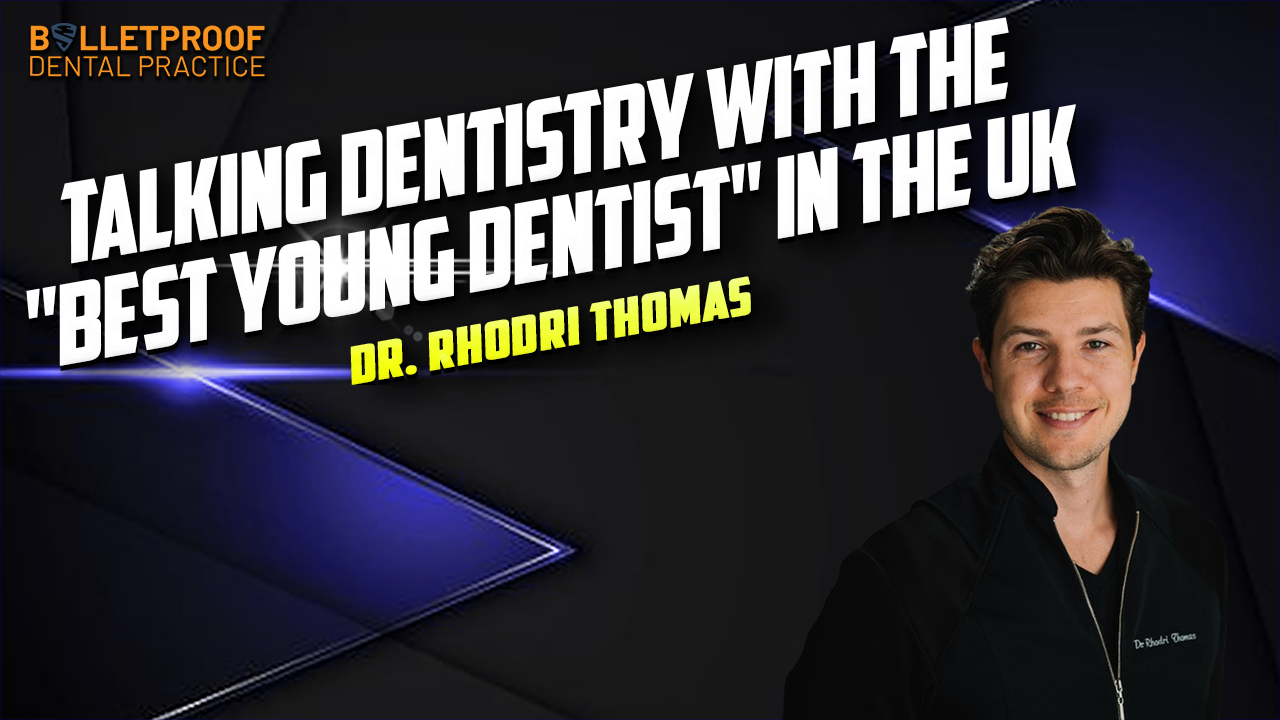
Hey everybody and welcome back to an episode of the Bulletproof Dental Practice Podcast. Peter and I have the distinct pleasure of having Dr. Rod Thomas on the podcast with us today. So, we were just getting started in figuring out all the ways we know each other. And we have a mutual friend with Dr. Andy Miro. Anyway, tell us a little bit about who you are, the courses that you do, and all that good stuff. And feel free to speak in your native British tongue. We can all understand you as we firmly established.
Rhodri Thomas
0:00:43
Sure. Thank you for having me.
Peter Boulden
0:00:46
It is a good thing he gave you permission to speak how you normally speak, Rod?
Craig Spodak
0:00:50
Right, because he could have just used the light. So like, anyway, I'm totally here, hanging out with my American friends.
Rhodri Thomas
0:00:57
I'll build up to a Florida accent. I appreciate that.
Craig Spodak
0:01:00
I appreciate you doing that.
Rhodri Thomas
0:01:02
But yeah, I guess I went to dental school, so we all make mistakes, but I am a dentist. And that was back in kind of 2014, I graduated. And then since then, I guess a lot of stuff has happened. And like you said, mutual friends, Andy Miro, and met a lot of really cool, great people along the way. And despite some early bits that I'm sure we'll kind of come on to later, I guess now there's a nice little brand, semi-building that's based around kind of educational, inspirational courses for dentists, all with like this aesthetic umbrella over the top of it all, which was kind of always the plan. So, it's nice that it's kind of coming together now. I always wanted it to be something a little bit different, international, and, you know, get to speak to people like you guys. So, yeah, that's a very, very brief interlude where I'm short.
Craig Spodak
0:02:04
Let me be your PR person for a second because I have you on my Instagram. Best young dentist winner consistently from 2016, that's pretty cool, all the way through 2022. At a certain point, you're going to have to relinquish that.
Peter Boulden
0:02:19
What is the award?
Craig Spodak
0:02:20
Best young dentist winner.
Rhodri Thomas
0:02:23
Best young dentist.
Craig Spodak
0:02:25
It's qualified as young, so I don't know how many years in a row can you win this? Because you do seem fairly young. You seem young.
Rhodri Thomas
0:02:34
I know, I look about 12, so it's very deceiving.
Peter Boulden
0:02:36
You look young.
Craig Spodak
0:02:36
And I'm glad we did this on YouTube,
Peter Boulden
0:02:38
because your hair is spectacular.
Rhodri Thomas
0:02:40
There are gray hairs back here. I promise. But yeah, it's a poorly worded award. I'll just start by saying that. And the only person that takes it seriously is probably my mother. So every year she is just psyched to win that. But yes, it's anyone under the age of 35 I guess can apply in the UK and they do it into regions which is why if you see some British dentists like I know you had Simon Shard came on your podcast.
Peter Boulden
0:03:08
Yeah.
Rhodri Thomas
0:03:09
Like I think he won it originally. He was like the original winner. Maybe I'm wrong on that. But I remember being in dental school and seeing someone win it. I thought, well, if someone else can do it, I want to try. It must be possible. But, yeah, so I've stopped doing it now. So this is the last, yeah, I'm not entering anymore. I'm going to take it off social media and put something else.
Craig Spodak
0:03:34
Okay, well, you used to be the best somewhat young dentist. I mean, that's a whole other category for you.
Rhodri Thomas
0:03:40
Yeah, absolutely.
Craig Spodak
0:03:42
But the best not old dentist. Peter, you and I should go into the best old irrelevant dentist of the year. The best middle aged dentist ever. Yes, exactly. Go on, Bill Dodd.
Rhodri Thomas
0:03:56
I never self proclaim it, I think just do simple stuff rather than too loud.
Peter Boulden
0:04:00
So was that a big, look, Craig says you have a lot of followers and stuff like that. I'm guessing it's equal parts patient, equal parts dentist, or are most of your followers that?
Craig Spodak
0:04:12
Tell me what the constituents of your following are.
Rhodri Thomas
0:04:15
Yeah, so I would say it's probably like 95% dentists.
Peter Boulden
0:04:19
Okay.
Rhodri Thomas
0:04:21
And I've probably only ever had two patients come to me from Instagram. Maybe three. Really? And yeah, that might be kind of geographically. I'm in Wales, so it's not kind of the dream location.
Peter Boulden
0:04:33
You don't have Instagram in Wales?
Rhodri Thomas
0:04:36
Yeah, I mean, we've barely got the wheel.
Rhodri Thomas
0:04:37
Kind of like China, they barely got the wheel.
Craig Spodak
0:04:41
We're working up to electricity.
Rhodri Thomas
0:04:43
Right, well, you have a really nice candle power glow
Craig Spodak
0:04:46
in the background, whatever that is. Thank you, thank you very much.
Peter Boulden
0:04:49
So, do you have your own practice, Rod? Or tell us a little bit about your come up. 2014 you graduated, and what got you here?
Rhodri Thomas
0:05:00
And then how did it kind of happen? Okay, I'll give you a little story. And if it gets boring, just feel free to cut in at any point in time. So yeah, I graduated 2014, and I guess back in Wales or back in the UK, you do this residency year. So it's kind of your foundation year where you go on to the National Health Service. And everyone kind of has to go through that little period. But I always knew the kind of dentistry I wanted to do wasn't kind of the health service dentistry. I always wanted to do private or fee-per-service dentistry. But everyone would say the same stuff, like, you can't do private dentistry until you're 35 or maybe 40, you can start kind of starting to do these little private bits. And I was adamant that I wanted to finish that residency and go straight to private industry. And everyone told me it was a mistake or that it wasn't possible, which I loved. I love being told that kind of stuff. And so during that kind of residency year, and Andy and I laugh about this because we both did a similar thing, people came and kind of gave lectures and education days to us. And my mom was a teacher, and that's always kind of what I wanted to do. And people would come along, and I would think, God, I would love to be one of these guys that are coming in and giving these talks. And so I would secretly, well, not that secretly, but I would make lectures for fun. So during that year, I kind of made these 10 lectures that no one knew about. My family were like, what are you doing? Why aren't you going out this weekend like you used to? And I was like, oh, I'm on lecture like number eight. And they'd be like, you realize no one's asked you to give a talk. And I would say, I'm very well aware of that. Thank you for bringing that up again. But one day someone will, and I'll be really prepared for it. And then at the end of that residency, the guy that kind of ran the whole thing asked me to come back and do a day. So I played it kind of cool and I said, I actually could do that. I put all 10 together and started kind of doing these little teaching days. It started really small, just in Wales and the UK. And then I managed to get that private job that people said I wouldn't be able to get. And it was just a matter of creating a clinical portfolio. And I would leave work instantly, drive to every private practice in like a 50-mile radius of where I lived, and I would just hand drop them off and try and come across as a relatively normal person of society, and then managed to get my foot in the door that way. And that kind of started then, and I kind of always stayed in private practice. I only switched once from the first job that I started. So I've been in the same practice now for probably six, seven years.
Craig Spodak
0:07:38
Tell us about the practice dynamics. A single doctor or a multi-doctor?
Rhodri Thomas
0:07:43
So when I first started, it was very different. It was kind of two dentists kind of in their 70s and one younger dentist, and he kind of owned it.
Craig Spodak
0:07:53
By younger, he was in the 60s?
Rhodri Thomas
0:07:55
He was in the 60s. No, he was probably about 40, 45, something like that. And he said, they interviewed a lot of people. And I'd quit my previous job. And so I was trying to play it cool in the interviews, but I actually was unemployed and making no money at all. And I was like, oh, yeah, it'd be great to hear back about the interview. And we had like three rounds of interviews. And eventually, they said yes. And so I started working there. But it was very old school. Compared to how it is now, it's changed completely. So now we have specialists in every area. I've probably gone from three surgeries to like 10, because they've expanded next door.
Craig Spodak
0:08:32
So it's- Hey Peter, by surgeries, he means operatories. So I just have to keep it, I have to translate for Americans.
Peter Boulden
0:08:38
Okay, so I was actually thinking that, I was like, 10 surgeries?
Peter Boulden
0:08:42
Yeah. Got it.
Craig Spodak
0:08:43
No, I'll translate, I'll translate.
Peter Boulden
0:08:45
Thank you.
Rhodri Thomas
0:08:46
But it's not quite on the scale.
Craig Spodak
0:08:46
Biscuits are cookies, I think too. Just a cookie. I like both biscuits and cookies. Is this important?
Rhodri Thomas
0:08:57
So operatory means surgeries. Surgery, yeah. It's coming back to me now. You guys do
Craig Spodak
0:09:04
call them ops or operatory. It's okay, yeah. I just want to make sure because when you had ten surgeries it's like, oh damn, you must have had a bad car accident or something, you know, into Americans.
Rhodri Thomas
0:09:15
Absolutely. So, yeah, it's kind of expanded now, and it's great. I'm just an associate there, so I don't own it or anything like that.
Craig Spodak
0:09:23
We did a podcast called I'm Just an Associate, by the way. There's no shame in that.
Peter Boulden
0:09:27
Greg doesn't like it when people say that.
Craig Spodak
0:09:29
Yeah, I don't like that. Yeah, I'm just a dentist. I'm just an associate. No, it's good.
Rhodri Thomas
0:09:34
I'm confidently an associate, I guess.
Craig Spodak
0:09:36
That's what I want to hear.
Peter Boulden
0:09:37
There we go.
Peter Boulden
0:09:38
Well, you're the youngest best dentist four times in a row. Like, you got that swagger. That's for shit sure.
Craig Spodak
0:09:45
Yeah.
Peter Boulden
0:09:47
Not at all.
Peter Boulden
0:09:47
And you know, and Craig, Simon, he was the previous winner of this.
Craig Spodak
0:09:54
I think he had won in a different geography. I don't know. Didn't he kind of look like Rod?
Peter Boulden
0:09:57
Like, good looking guy. Like, I think they just give it to good-looking guys.
Craig Spodak
0:10:03
Well, they probably have some good-looking girls there. I'm Googling best dentist in the UK right now when I see these.
Peter Boulden
0:10:08
Right, yeah.
Rhodri Thomas
0:10:09
They do indeed.
Peter Boulden
0:10:10
Anyway, sorry, I digress.
Craig Spodak
0:10:11
But then you started, what really got me thinking and what really had me wanting to meet with you is this amazing course that you're teaching. You know, and I don't wanna mess it up, but what lit me up, I know you teach many courses but the direct resin course, you have that, correct?
Peter Boulden
0:10:31
I just want to make sure.
Rhodri Thomas
0:10:32
Yes, that's the flagship.
Craig Spodak
0:10:33
Yeah, I just love that. I think that's so cool that we're having, you know, that you're doing that.
Rhodri Thomas
0:10:41
It ran at Nova a couple of years ago, just before COVID, so I was in Florida. If I'd known you guys back then, I mean, it would have come straight over.
Peter Boulden
0:10:50
Which I love.
Peter Boulden
0:10:51
What made you decide A, that was a passion, and B, that was a niche you wanted to get into?
Rhodri Thomas
0:10:57
I think, you know, I always thought I was gonna be like a Max Fax surgeon. That was kind of, when I went into dentistry.
Peter Boulden
0:11:05
A what?
Peter Boulden
0:11:06
Oh, like a oral surgeon?
Rhodri Thomas
0:11:08
Yeah, maxillofacial kind of stuff.
Craig Spodak
0:11:10
I never heard of Max Fax, I like that. I've never heard that. If no other reason, Rod, this is so cool, to get our British dental jargon, if you are a dentist in the UK and you've been listening to us, please comment below and we are going to do this now. Surgeries, operatory surgeries, max thumps. Max thumps.
Rhodri Thomas
0:11:27
I like it. Yeah.
Rhodri Thomas
0:11:29
And then there's rugby ball burr that you guys call the football burr.
Craig Spodak
0:11:33
Yes, of course. It's a rugby ball burr.
Peter Boulden
0:11:36
So much.
Rhodri Thomas
0:11:37
It all comes out on these courses.
Peter Boulden
0:11:38
No way.
Craig Spodak
0:11:39
Yeah, but it's true. It's not a football-shaped burr.
Peter Boulden
0:11:41
It seems like a clunky name, rugby ball burr.
Craig Spodak
0:11:44
No, it's just an RBB. Everybody knows that, Pete. Pass me the RBB, you football burr.
Peter Boulden
0:11:52
Yeah, you know me.
Craig Spodak
0:11:53
You dealt with RBB? For cingulum reductions, it's amazing. Great lesson. Listen, we got to get serious here. Sorry.
Peter Boulden
0:12:02
Go ahead.
Rhodri Thomas
0:12:03
No, I'm enjoying it. I've got a whole list. But yeah, I thought that was what I was going to do. And then it kind of got to, I mean, this was like 2009, 2010, a lot of great TV series came out at that point in time, like Prison Break, for example. So I missed all of the oral surgery tutorials and all that kind of stuff. I wasn't the most diligent dental student, I don't think, in its early years. So when we first came to take out a tooth, I was unlucky. I was in the first group. And I tried to get out of it and say, you know, I was sick. I didn't manage to go to all the tutorials. I'll just watch today. They're like, no, you've got to do it. You've got to get in there. And it was just myself, no assistant, and just this guy in the chair taking out a molar tooth. So I got a numb, and I was like, that's a great start. That ID block worked. And then I told them, I just got to go to the bathroom and I kind of YouTubed two or three videos of people taking Apsagee and I went back in there and kind of put this 45-minute show together and the tooth eventually came
Craig Spodak
0:13:12
out but I ended up with PDSD I think from the whole thing. I realized yeah oral surgery wasn't for me but then we
Rhodri Thomas
0:13:26
that led on to kind of… Well it might be you've just got your training on on YouTube so that probably was factor number one. I went to play tennis with a very well renowned, world renowned tennis player in the middle of the first set I went off and watched a YouTube video and then decided that's awesome. It's good to admit these things, you know. Of course. And then, yeah, that kind of killed the love for me a little bit. And I instantly was like, I love this. Because I hadn't really found anything that really excited or engaged me too much. And we started waxing his teeth up, and I was like, oh shit, this is like sculpture all over again. I feel like I'm doing art. And so that was kind of my passion before dentistry. I wanted to be an artist, but with some parental advice, they thought maybe this was a more stable career path. My sister said, you know, I think you'd love it and you can kind of make it as creative as you want. But I kind of forgot about all of what she said in those first few years. And so once I found that, it wasn't long before we started doing composites or composite, as you guys like to say. And then that was like another level. And so that was just a game changer. And I became, I would say, probably unhealthily obsessed into reading and watching everything I could from Wales about composite resin while at dental school. And I would just watch stuff on repeat. So I'd see these buddy
Peter Boulden
0:14:35
mock videos. From Wales? You said you were obsessed with watching stuff from Wales?
Rhodri Thomas
0:14:39
Yeah, I mean, like, yeah, I'd just get home from dental school and I would spend my evening literally learning. While you were in Wales. You weren't looking at like Brazilian or American.
Craig Spodak
0:14:51
Yeah, that's the way I heard it too. I heard that you're only interested in Welsh cosmetic dentistry.
Peter Boulden
0:14:56
Wales cosmetic dentistry.
Rhodri Thomas
0:14:58
That would be very limited material.
Craig Spodak
0:15:00
That's what I heard by the way. So I'm glad you, I'm like, wow, he wants to get geographically specific with techniques.
Peter Boulden
0:15:06
Yeah.
Peter Boulden
0:15:06
You know.
Craig Spodak
0:15:07
It was a great guy in Brazil.
Peter Boulden
0:15:09
Because for a while there, you know, in the UK, it was cosmetics and cosmetic dentistry and the UK were diametrically opposed. Yeah, yeah, true. You guys kind of, you led the way.
Rhodri Thomas
0:15:19
Right, that's what I'm saying. So when you were saying, hey, like I dug into everything
Peter Boulden
0:15:23
I could find in Wales composites, but that's not what you, that's not what you meant. You were just saying you became obsessed learning all the things about composites.
Rhodri Thomas
0:15:31
I guess so, within the limited geographical region of Wales. And then, yeah, that meant I came across kind of Newton Foll, Buddy Mopper, all these kind of great names. I would watch what they were doing just on repeat, literally for hours. It was weird. I would just do that. And I would want to know how they were moving the flat plastic and how thick all their layers were. And then I just kind of felt like that would be the easiest thing to, at that stage, and probably for a lot of people graduating, something you could kind of get pretty adept at relatively quickly. And then it kind of branched out into the whole umbrella of aesthetics I guess, and so that's kind of where the passion started. I was kind of, I would start to see it as like an art studio, and then instead of paint it was kind of resin, and I I kind of loved it from there. I just loved making all these things and then these little transient artworks, I guess. And then I really wanted to show other people some little bits I kind of made up myself about how to do it. And yeah, it kind of kicked off from there, I guess.
Craig Spodak
0:16:39
So what's your vision? Is it through practice or through the courses? Like, what is your… What's driving you right now?
Rhodri Thomas
0:16:47
Good, good questions. I'm loving these questions. I feel like we're talking about me too much, but I'll go.
Craig Spodak
0:16:53
Well, you're the guest.
Rhodri Thomas
0:16:54
Yeah, this is true.
Craig Spodak
0:16:56
Peter and I have been known to ignore our guests and completely go off direction, so.
Peter Boulden
0:16:59
You could have been the guest listener, Rod, and just had to listen to us just banter weirdness back and forth to each other.
Rhodri Thomas
0:17:07
Feel free at any point.
Craig Spodak
0:17:08
We might do that.
Peter Boulden
0:17:09
The pod's not over yet, so I'll tell you.
Rhodri Thomas
0:17:13
So what was the question again, sorry I got lost?
Peter Boulden
0:17:16
No, I'm just…
Craig Spodak
0:17:17
You can't make this up.
Craig Spodak
0:17:19
No, I'm just, I was saying like what's fueling you? Is it the… That was it. Yeah, is it more the lecturing or is it more the private practice stuff? Like what's getting you, where do you see Dr. Thomas' future going? Sure, so when I first started,
Rhodri Thomas
0:17:34
I was working six days a week and three of those days were eight to eight, and so it was like just all dentistry. And then I realized that wasn't sustainable long term, and I really wanted to branch out more into that stuff. So now it's kind of tapered down every year. So now it's kind of two or three clinical days, usually three. I've got a little gig I do with Cosmodent, I guess, as well, and then the rest of my time is purely devoted towards.
Craig Spodak
0:18:04
What's the gig with Cosmodent? What is Cosmodent?
Peter Boulden
0:18:07
Is that a manufacturer, correct?
Rhodri Thomas
0:18:09
Yes, they make resins.
Peter Boulden
0:18:11
Resin, they make a good, like, micro-filled, not micro-filled, is it like, what's the, it's like been the standard forever and ever.
Rhodri Thomas
0:18:19
In Cosmodent, interior composites.
Rhodri Thomas
0:18:21
I think like 70% of AACD cases use.
Craig Spodak
0:18:24
Yes, what's it called? The accreditation cases, right? Yeah, cosmonaut that basically comes the prop. What's the product though? Oh They got a whole world of products renamel composite, but there's a renamel. That's what yeah, that's what it was. Okay. Got it. So part of my lack of understanding about you know, a CD a CD cases, but you're talking about Getting accredited for direct composite veneers, correct? Is that what we're talking about?
Peter Boulden
0:18:51
No, it's one of the five case types. Okay. Right, and one is a direct bonding case, one is an eight unit veneer case, one is a tooth replacement case, like so.
Craig Spodak
0:19:01
I always forget, Peter, you're like an AACD guy, right?
Rhodri Thomas
0:19:04
Yeah, well.
Craig Spodak
0:19:06
Aren't you accredited?
Peter Boulden
0:19:07
Weren't you?
Peter Boulden
0:19:07
Back in the day, back in the day, Craig.
Craig Spodak
0:19:09
Talk to me, let's talk.
Peter Boulden
0:19:10
Anyway, no, right.
Craig Spodak
0:19:11
No, weren't you though? Weren't you an AACD guy? I was. Yeah, it's a big deal man, be proud of that.
Peter Boulden
0:19:18
Yeah. Rod, so yeah, what is Cosmodent have you doing? Is Buddy Mopper still around by the way?
Peter Boulden
0:19:26
He is, he's going strong.
Rhodri Thomas
0:19:27
I think he ran a course the other week. That's amazing.
20
0:19:32
Yeah, he was just an absolute.
Peter Boulden
0:19:34
He's an OG and like, man, he's been around for a long time.
Rhodri Thomas
0:19:39
I think the first AACD I went to was like 2016. I saw him teaching then, and I was…
Peter Boulden
0:19:45
The first one I went to was 2001, he was teaching then.
Rhodri Thomas
0:19:50
Yeah, the guy's a pioneer and a legend, for sure. Great guy, and they're a great team as well, like such a good family company. Best people I've actually ever worked with. I can honestly say that they're amazing. See, I just kind of come up with educational videos, I guess you could say. That's what I make the Cosmodent. For Cosmodent?
Peter Boulden
0:20:11
Yeah. You do training videos on behalf of them?
Rhodri Thomas
0:20:14
Yeah, amongst other kind of little bits and pieces. But yes, I've been doing that for the last year or so now and that's pretty good. I'll be flying out there in two weeks or so running a course with them.
Peter Boulden
0:20:28
So where do you see the future of… I've seen some really cool stuff coming up. Actually,
Craig Spodak
0:20:35
Craig, I'll tell you who does some really cool stuff in Utah. It's Jordan.
Peter Boulden
0:20:41
Yeah.
Craig Spodak
0:20:42
One of my docs is going through his course. The technology… Look, it used to be funny when someone's like, hey, I want a durable interior case. I want you to redesign my smile, you'd be like, well I can do some composite,
Peter Boulden
0:20:55
but it's more than likely gonna chip in time
Rhodri Thomas
0:20:57
and look bad.
Peter Boulden
0:20:58
The technology has come so far with obviously being the hybrids and micro fills and all the things that it's becoming almost,
Rhodri Thomas
0:21:08
how do I say this?
Craig Spodak
0:21:09
It's compelling, it's compelling now.
Craig Spodak
0:21:10
It used to be pretty binary. If you wanted something pretty, you had to go porcelain. No, it wasn't. No, composite was always pretty. Well, I mean, if you want something durable and long-lasting. But I mean, yeah, for me, when I see these cases, you know, Marshall Hansen and Jordan Davis and one of my doctors, Dr. Lee Zell, is doing it. It is just bonkers.
Rhodri Thomas
0:21:32
It's amazing.
Craig Spodak
0:21:33
It's bonkers. And I mean, then you don't have to take away your tooth structure, and if something does chip, you can just easily bond back on. I mean it's not a question of if it's going to be better, it's probably, you know, or when it's an if I think.
Peter Boulden
0:21:46
Rod, are you into indirects at all or is mainly, is your course mainly on just direct manipulation of composites onto teeth? You write direct veneers.
Rhodri Thomas
0:21:59
I mean like clinically I'd say I probably do more indirect, actually.
Peter Boulden
0:22:04
Indirect resin or indirect composite? I mean, I'm sorry, indirect resin or indirect porcelain?
Rhodri Thomas
0:22:09
I mean, like, indirect ceramic is probably what I do more clinically. But the resin courses, yeah, that's just all pure, direct resin. And then…
Craig Spodak
0:22:18
Why do you do clinically more indirect porcelain, not direct resin?
Rhodri Thomas
0:22:23
I think for me, it's just because of where my practice is, I'm treating mostly farmers and criminals, no I'm joking, but they're mostly kind of an older crowd. So a lot of the time it's kind of 60 and above are the kind of patients that I'm getting. And sometimes when they're coming in for makeovers and we'll talk about kind of pros and cons of both materials, more often than not, they're kind of at that stage where they're like, I just want to have it done now, and something that's just not gonna have maintenance involved or anything like that.
Craig Spodak
0:22:56
Are you dealing with an older demographic? Is that what I'm hearing you say as well?
Peter Boulden
0:23:01
Maybe what you're saying, older farmers.
Rhodri Thomas
0:23:03
Yeah.
Rhodri Thomas
0:23:04
Yeah, I pretty much see, I'd say like, last year, five people.
Peter Boulden
0:23:07
Is that challenging for you to be teaching something and saying, guys, here, and then to be applying not as much as you'd like to in your career life?
Rhodri Thomas
0:23:20
No, I don't think so.
Peter Boulden
0:23:22
You're a clinical practice, okay.
Rhodri Thomas
0:23:24
Yeah. I guess all the previous years, even though you could say there can't be that many because I looked 12, it's been very resin heavy. So I've done a lot of resin. It was pretty much just all resin for a really long period of time and then I think naturally, you know, a lot of those hand skills and bits like that kind of follow in nicely to indirect stuff as well and understanding, talking to a technician better because of you've gone through layering and you've seen mistakes and seen those 3D elements of how much tooth space you might need and light and shade and color. And so it was useful to have that as like a base to then go on to do some of the more indirect stuff and ceramic bits and pieces. But now I think it's just kind of a blend and it's what's gonna be right for that patient at that stage in their life, I guess. But I…
Peter Boulden
0:24:19
Are you into 3D scanning and things like, and digital printing at all?
Rhodri Thomas
0:24:23
Yeah, yeah, pretty much most ceramic cases that we do probably go digital. Some of the really minimal veneers I'll still go kind of analog with that kind of stuff. You go digital meaning you 3D scan and then you mill them? Yeah, so I won't mill the restorations myself or in practice. We haven't got the CEREC or the PrimeScan, but we're using iTero. I'd like to get a 3-shape but we're using iTero right now and I send that off the technician and he will… well initially I would send him the analog and the digital option. I tell him, you know, pick what's best and then we found, you know, depending on how much structure I was removing, that most of the time digital was actually kind of going to work really well and from that he'll go ahead and get it printed off and then make his restorations from there. And depending which technician, some of them will mill kind of that little inner coping, and then they'll build on top of that, and some of them will just go.
Peter Boulden
0:25:24
Have you seen some of the products, Craig, and this goes to you,
Craig Spodak
0:25:27
the products that are coming out from a print resin?
Peter Boulden
0:25:32
Yeah, I have. There's composite, there's composite, they're 50% porcelain proof they're now approved for indirect restorations and in my opinion it's going to categorically change the profession holy shit I know because now you're talking about the thinness of what you're talking about Craig from a cosmetic you know you talk about you know if you're not aware of this wave coming where I'm let me pause for a second I think there are inflection points in technology where yes we've had CAD CAM for a while, yes we've had in-house millers, but you start talking about being able to 3D design and 3D digitally print something in your
Craig Spodak
0:26:13
office, not in a wet lab or milled scenario, it's going to be a game changer. It's an inflection point. I mean the milling was a game changer too, it's just a barrier. Yeah, but not practical Craig for most offices to get in. Right. I can speak for someone who's had two millers in my office and the quality, maybe it was just I had bunk machines, was not there. Yeah, when did you evaluate machines? Yeah, this was early on. Okay, so 2008, maybe was the first one. Oh, yeah, yeah, yeah. And then 2014, we tried to get… My Motorola StarTAC in 2008, by the way, that flip phone. Yeah. All right. Well, twice bitten, not going back. No, I know. But yes, to your point though, I was just making light, the printing technology is a game changer because of its application and ease of application. And the resins are phenomenal. Because I think for dental materials, we went with like, you know, tensile strength and ignored like flexural strength. Totally. And teeth, like we're like, oh, zirconia, it's amazing.
Craig Spodak
0:27:10
You can drive over it.
Peter Boulden
0:27:11
It's so strong.
Craig Spodak
0:27:12
It's stronger than the tooth. It's so strong. Yeah. It is stronger than the teeth, but you know when God makes teeth like strong and flex Flexible right I think the resins that I'm seeing and again. I'm I'm way over my head kind of this conversation But I'm happy I'm happy to keep going it just to me It has the flexural strength that mimics to structure and the adaptation my lab just gave me an a printed inlay Holy shit couldn't get it out like it was just like so Craig the only reason I'm bringing this up actually it's apropos for where we are today, I'm literally in 15 minutes, you know one of my associates who's hands down like one of the most advanced digital dentists I've ever seen, coming over to talk about a building in this headquarters, just a digital lab, with all of our printers, and going full steam into what we were just
Peter Boulden
0:27:55
kind of talking about.
Craig Spodak
0:27:56
Yeah, we're doing the same. I'm doing 2,000 square foot lab now. Do you know that Peter? My new building.
Peter Boulden
0:28:02
I knew you were expanding, but I didn't.
Craig Spodak
0:28:03
See Rod, this is the part where you just have to listen,
Peter Boulden
0:28:05
by the way.
Craig Spodak
0:28:06
No, I'm loving it. I'm learning a lot.
Rhodri Thomas
0:28:08
I want to come to Florida.
Craig Spodak
0:28:10
Yeah, so yeah, we're expanding it by four times. But it's gonna be cool, this next run. We just bought the photogrammetry scanner, too. We just bought the PIC scanner. No way. Yeah, we just bought it. So we're number 44 on the list. So I think they started shipment already, so we got the brand, brand new PICS scanner. It's like ordering a Tesla. Yeah, it's about the same price too as a Model Y, I think. No, it's definitely not like a Plaid. What's a Plaid? Plaid's like the one that goes 0-60 in one second or something ridiculous.
Peter Boulden
0:28:43
How much is a Model Y Tesla, by the way? They're not that bad.
Craig Spodak
0:28:47
I know, this, yeah, 70 grand-ish. I'd say $70,000 probably. Yeah, I think the PIC scanner is like 50, 40 something. 45, 50. Who knows? Just a rounding error at this point, right? Who knows?
Rhodri Thomas
0:29:05
Wow. I do love the look. I saw some of those videos when I was just talking through your social medias, inside the practice, and really cool, really cool art and open space.
Peter Boulden
0:29:21
We are advocates of the patient experience.
Craig Spodak
0:29:23
We just finished the podcast right before you were talking about marketing, understanding your marketing, it's partly just your brand. People don't think, unfortunately dentists don't think it matters, technology facility teams, it matters so much, especially in the US. I can't speak to how dentistry is in the UK, but it's just, it's become so, there's a lot of really neat offices that are springing up all in urban areas that are really slick, like booking appointments and you know, online, and it's just, it's just forcing all of us American dentists to really level up. I'm sure it's coming, you know, to you guys as well, I'm sure, and the Dent City Center's there already.
Peter Boulden
0:30:00
As soon as you guys get Instagram, it's going to be there.
Rhodri Thomas
0:30:03
Yeah.
Peter Boulden
0:30:04
Yes, absolutely.
Craig Spodak
0:30:05
Well, they've got to get power first because- Power first. Power, then lights, then running water, then Instagram. But I'm sure they have good beer. It's pretty much.
Peter Boulden
0:30:15
So what do you, as a younger dentist, young and best dentist, what are you most excited
Peter Boulden
0:30:20
about right now, Rod?
Rhodri Thomas
0:30:21
On like a personal level or as like a-
Craig Spodak
0:30:25
For profession. For profession. But I thought you'd know personal, too.
Peter Boulden
0:30:31
I wouldn't.
Peter Boulden
0:30:32
I don't really.
Rhodri Thomas
0:30:33
I'm just kidding.
Rhodri Thomas
0:30:34
We'll do both. I think the digital bit you guys were talking about, if you see how much it's changed just in the last… since I graduated, since 2014, it's been pretty mega. So another 10 years of that would be a whole world of stuff I imagine we'll be able to do. I mean, I can see stuff that other people are doing where it's fully digitally led in terms of, you know, the 3D scans, they're doing all the digital face bows and all this really interesting looking stuff, taking it from start to finish, knowing exactly where it was going to go from the beginning. I kind of always like some of the kind of master ceramics touch or the hand touch stuff, personally.
Peter Boulden
0:31:16
Because you're the artist, right? And that's where the artistry. Do you believe that that will be affected by this next inflection point of technology?
Rhodri Thomas
0:31:29
I think it'll always be there. I think you'll always, a bit like in anything, like you could still go and buy beautiful handmade furniture.
Craig Spodak
0:31:38
I disagree, too. I think they're all gone. Really? Yeah. So I see the hand-touched ceramist disappearing. They don't exist anymore. It's just the hand.
Rhodri Thomas
0:31:49
Even like a hybrid where maybe the technology does 80% but then you have someone come in
Craig Spodak
0:31:55
and- I think the technology gets pretty automated and then the artistry is done by-
Peter Boulden
0:31:59
It will probably be a finishing tech, right?
Peter Boulden
0:32:01
And that's where the-
Craig Spodak
0:32:02
No, it's not a tech. It's probably an assistant that gets their course and learns how to spin and glaze.
Peter Boulden
0:32:06
I'd hate to say that that is… that technology is going to dematerialize that industry.
Craig Spodak
0:32:14
Tell me where are the U.S. ceramic technicians? Where are they? Where are they right now?
Peter Boulden
0:32:20
Edward McLaren.
Peter Boulden
0:32:21
I'm sorry?
Rhodri Thomas
0:32:22
The first one I could think of was Edward McLaren.
Craig Spodak
0:32:25
And how old is Edward? I don't know.
Peter Boulden
0:32:28
Oh, I don't know.
Peter Boulden
0:32:30
He's a dentist.
Craig Spodak
0:32:32
Yeah, you can't rule him out. Tell me just an iconic US, American dental technician that's still relevant and practicing.
Peter Boulden
0:32:41
So what I'm trying to say is that the reason,
Craig Spodak
0:32:43
it's the economics of the US Dental Lab. Whereas they would be paid $300 for that one veneer, they could mill out a puck of zirconia at $89 or $99 a unit and do 20 of them so much faster. So the economics have driven it. So we have to now, when we're looking for that old world artistry, we have to look to second and third world countries. The best technicians are Brazilian and they will move from Brazil to America because of a better life. It's not because they have other opportunities. So there's economic forces at work that I think destroy this artistic profession that we've all come to love. I think the economics destroy it. The technology, I mean.
Peter Boulden
0:33:30
Have you guys heard of, speaking of this, have you heard of, so you talk about digital artists, Greg.
Peter Boulden
0:33:36
Yeah.
Peter Boulden
0:33:37
Have you heard of this thing called Dali? D-A-L-L-E? No, I've heard of Wally. I love that. No, it's not Wally. So, Dali is a, it's basically an AI platform that you type in, show me a picture of Bulletproof Craig and Pete on top of a mountain, and it'll give you back a beautiful, beautiful sketch of this, of whatever, maybe that wasn't the best analogy. Give me, give me a, you type in there, give me, give me a mushroom eating a strawberry or something, right? And it'll give you back all these renderings of these beautiful, unique art done by AI. Yeah, it's all AI. Which used to have to be, so where I'm going with that is it's being dematerialized, digitized into a, and it's being disrupted by AI. There's actually term papers that can be written now by this technology called GPT-3. Same kind of thing, it's using big data. And you know, like on your Gmail, you have that Grammarly, right? Do you have that on yours?
Craig Spodak
0:34:40
Yeah, I have it on mine, yeah.
Peter Boulden
0:34:41
Yeah, so guess what that is doing? That is taking data that we are typing in our emails and aggregating it to big computers that then allows this GPT-3 to say, hey, make me a term paper on the science of computers or something like that. And it spits you out a paper and content like that. So now you can produce content for your blogs and stuff like in dentistry and they're pretty good, believe it or not. Like they are uniquely done because they've been trained by people's emails and our verbose and our punctuation and all that stuff, they've been training and they just have this massive subset of data. So, when I see things like this, Craig, I'm only reinforcing your thing about, you know, artistry potentially getting disrupted by technology and AI is we're seeing it live. Where digital artists are now being, you know, where you have to say like, hey, I really want this picture of someone from my website to look like this. And you tell an artist what you're looking for and they get in Adobe Photoshop and they make you some sketches of stuff and they're like, here you go, that'll be $300. Uh, it wasn't really exactly what I wanted, but like, okay, right? And now, to be able to do it as a service for free or for pennies is crazy. And to have them spit out like that is crazy.
Craig Spodak
0:35:59
Same thing with that GPT technology. I think dentistry would be better served if patients had templated teeth to choose from, models. You know patients, it's the paradox of choice. Like the artist's interpretation, the dentist's interpretation of what your temporary should look like, then the patient's feedback and then the artistic interpretation of the lab screws everything up. Patient agrees to their temporaries, they love it, then the tech wants to get fancy. So if patients could just like with a digital preview, say I want the model A in color this, and then show them a video with sophisticated colors.
Peter Boulden
0:36:38
And then almost like live type, like putting in color like this.
Craig Spodak
0:36:42
And then here, go home with those five videos or each two minutes each, and tell me what style you like. Do you like the Luxor? Do you like this style? And then what color? And then show them all that and take the guesswork out. And now you've just disrupted their technician entirely.
Peter Boulden
0:36:59
Well, but to be able to do that in such a small footprint, meaning most dentists have the scanners, right? We've already kind of taken that as, we've adopted that as being better technology than PBS, right? It's now past that inflection point of being better. It's more accurate. Okay, so now, if the only other piece of equipment that you need to put in your arsenal, your armamentarium, is a digital printer that can potentially put in resin, is that not a game changer? When you tell me I had to put in a miller and get a ceramist and all this other stuff, I ain't doing all that, I ain't doing all that.
Craig Spodak
0:37:30
I'm still studying the piece. But imagine though, if the patient understands what they're getting and just through software, not even hardware, but software, has the ability to have a 3D movie of themselves with three different models and colors of teeth. Now it doesn't matter where the fuck the printer is.
Peter Boulden
0:37:44
Using an Instagram filter to put their new teeth inside their face.
Craig Spodak
0:37:48
And then show it, and then they agree to it. There's just too much choice in dentistry. I kind of like them squarish, tapered. There's too many choices. People really just probably need 10 or 12 sets of template of teeth, male and female, and then length could be determined, and then everything else is the same. God doesn't make that many variations of teeth. We offer them too many variations. And part of the reason why patients get pissed off is because a lab technician doesn't make the teeth look real enough. So I just think that, to come full circle, I think that the dental lab industry has no more talented hand-painted technicians within 10 years, none. I mean, there might be the same guy that you pointed to, the Italian shoemaker that practices in rural Italy that charges you $1,000 for shoes, but that's not practical. You and I are not getting our shoes there.
Rhodri Thomas
0:38:40
Yeah.
Craig Spodak
0:38:40
I think I just upset Peter, by the way. He just walked off.
Rhodri Thomas
0:38:43
He couldn't take the heat anymore. I think-
Craig Spodak
0:38:46
He got too angry for him.
Rhodri Thomas
0:38:48
It probably something like that will evolve probably I reckon pretty soon as well in the next under five years but I will always Want it to be Dentally driven which is kind of against everything you just said Craig, but I kind of want my input into the whole thing Designing it and suiting it Similar as I think visions don't quite know what they want or they want the wrong thing.
Craig Spodak
0:39:15
Yeah, but if it's what they want, it's not wrong. That's what they want. I mean, who would ever thought that patients would want to order their orthodontics online? I never thought they would, but they sure did.
Peter Boulden
0:39:27
That's what I was just thinking of as an example, Craig.
Craig Spodak
0:39:31
Yeah, so our opinions are obviously wrong about what the consumer wants.
Rhodri Thomas
0:39:35
We should have thought of that.
Peter Boulden
0:39:37
We should have done this years ago. I'm actually seeing that technology, I actually saw, not to bring up Instagram again, but I'm actually seeing that technology on like Snap-on Smiles at home, right, where people are doing that same Invisalign model, Craig, they're taking their own PBS impressions at home, and now they're getting, to your point, pick from a template, we'll print you these veneers and send them back to you, so they're totally disrupting the clinical side of dentistry not to mention the lab side. We're skipping two people Yeah, I know
Craig Spodak
0:40:07
So yeah anyway very interesting right that was awesome. I appreciate you taking the time with this man. It's it's good
Peter Boulden
0:40:13
You have anything else in closing or all right?
Craig Spodak
0:40:15
Well, how do we get in touch with you? And how do how do people that want to learn how to do Welsh direct veneers come? So the the art of dentistry
Rhodri Thomas
0:40:24
Courses is kind of what it's called. So you can find it through my own Instagram through dr. Roger Thomas You have a website as well or no. Yes, there's a website you can book your tickets on there. What is the website? out of dentistry courses calm
Peter Boulden
0:40:38
Art of dentistry courses calm we will put that in the show notes I hope to meet you in person one day, bud, and hope you can come maybe to the next summit or something next time you're on this side of the pond, as we say. I think Andy and I are planning a tour to Florida next year, so we'll be around. I want to come.
Peter Boulden
0:40:58
Yeah.
Rhodri Thomas
0:40:59
Tell me when, and I promise I won't suck up as much oxygen as I did today.
Craig Spodak
0:41:04
That is, hey, just so you know, Rod, that is fake news. He will suck up all the oxygen.
Peter Boulden
0:41:08
He tells you he won't, but he'll suck it up.
Peter Boulden
0:41:16
Fake news.
Rhodri Thomas
0:41:17
I much prefer the energy on a course, by the way. It's great.
Craig Spodak
0:41:22
Oh, I'll bring it.
Peter Boulden
0:41:24
Yeah.
Craig Spodak
0:41:24
Well, thanks for your time.
Rhodri Thomas
0:41:26
No worries, thanks so much, guys.
Peter Boulden
0:41:28
Thank you, Rod. We'll see everyone next time on the Bulletproof Dental Pod.
Peter Boulden
0:41:32
Over and out.
Peter Boulden
0:41:33
See you guys.
Craig Spodak
0:41:34
Yes. ♪ This time baby I'll be ♪ ♪ This time baby I'll be ♪ We'll be back.
Transcribed with Cockatoo
Bulletproof Summit
Mighty Networks: Bulletproof Dental Practice
Cosmedent – (https://www.cosmedent.com/product-category/dental-composites/)
DALL-E – https://openai.com/dall-e-2/
The Art of Dentistry – https://artofdentistry.co.uk/