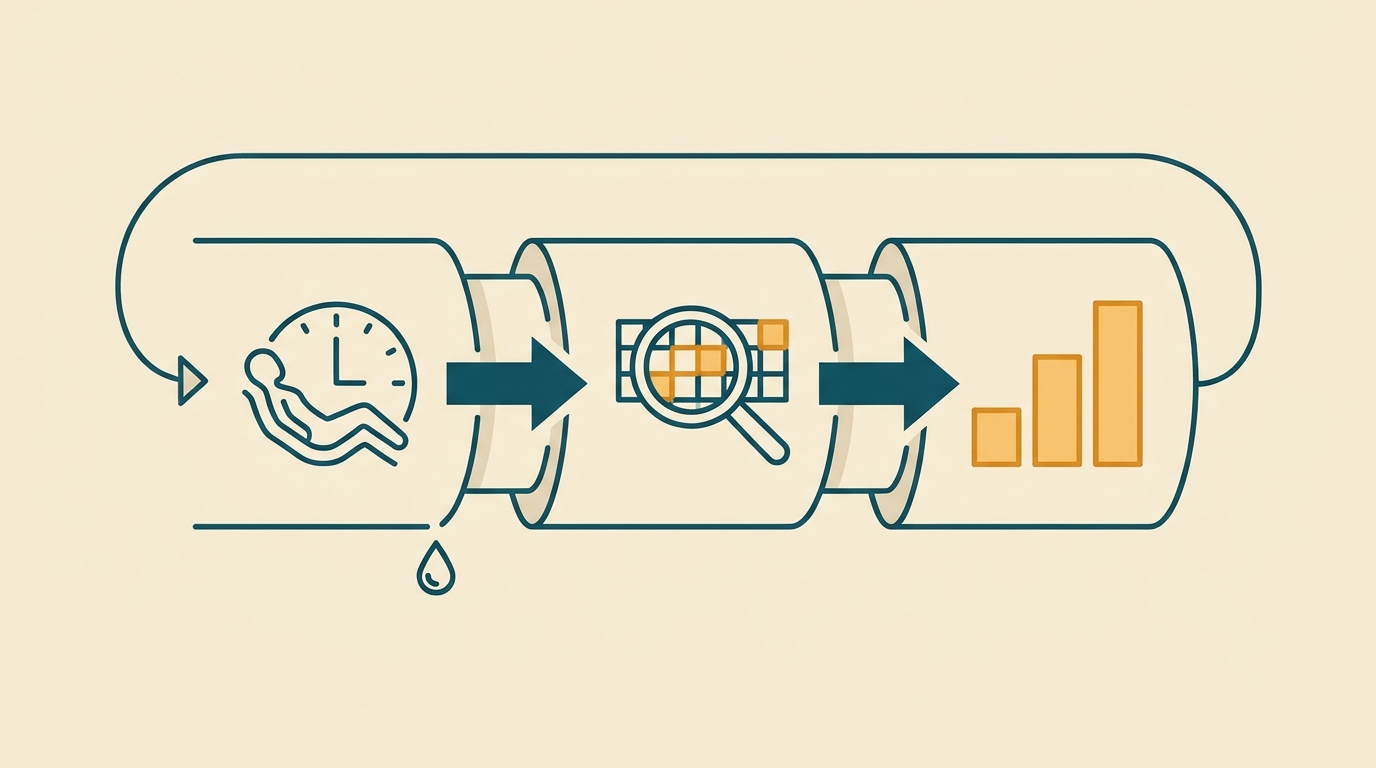

A dental practice consultant audits fee schedules by tracing every dollar from the signed payer contract to the posted payment — comparing contracted allowances against the fees loaded in your practice-management system, the adjustments your team posts, and what each payer actually remits. The leaks hide in four places: wrong fees in the PMS, incorrect contractual write-offs, payer downcoding and underpayments, and denials that never get worked. Fix those four, and most practices recover five to six figures a year.
That's the short answer. Now let's prove it.
A fee schedule leak is the gap between what your contracts entitle you to collect and what your practice actually records, bills, or receives. It shows up as outdated UCR fees, stale PPO allowables, write-offs calculated against the wrong contract, downcoded claims accepted without appeal, and timely-filing deadlines missed on denials. No single report surfaces it. That's why it persists.
Here's the uncomfortable math. A practice doing $1.5M in gross production with a 30% PPO write-off nets only $1.05M before any collections problem, according to bulletproofdentalpractice.com. If your loaded fees are below contracted allowables, or your team is posting adjustments off an old fee grid, your production number is already fiction. You're writing off money you were contractually owed.
A consultant audits the fee schedule by pulling your signed payer contracts, the fee tables loaded in your PMS, and twelve months of EOBs and remittance advices, then reconciling them line by line by CDT code, payer, and effective date. Discrepancies get logged by root cause — PMS entry error, outdated contract, payer downcoding, or denied/unappealed. Then dollar impact is quantified per payer.
Bulletproof Dental Practice, which has spent 10 years helping dentists understand the business of dentistry, frames this as a contract-to-collection audit. The specific steps:
The biggest leaks hide in four categories: outdated PMS fee tables, incorrect contractual adjustments, payer downcoding, and unworked denials. Each one bleeds differently. Together they're the reason a practice can hit its production targets and still miss its collections number by six figures.
The denial piece is bigger than most owners think. The all-payer initial denial rate reached 11.8% in 2024, up from 10.2% in 2020, according to industry reporting. Most of those denials go unworked — and a significant share of the ones that are appealed get overturned. The majority of recoverable dollars are left on the table.
One documented example: a billing office had 42 claims denied once and never resubmitted from a single month. All were past timely filing by the time anyone looked. The total, according to harriscaretracker.com, was just over $11,000 in unrecovered revenue — from one month, from one office.
Recoverable revenue depends on contract mix, payer behavior, and claim volume — there's no universal number. But the ranges are meaningful. Fee-table corrections stack on top of recovered denied claims, compounding the total recoverable amount.
The collection-ratio math makes it concrete. The elite standard collection ratio for a dental practice is 98–100%, per bulletproofdentalpractice.com. A practice netting $100K a month and collecting $91K leaves roughly $108K on the table every year, according to the same source. That's one associate's salary. That's your retirement contribution. That's the leak.
A consultant fixes fee schedule leaks by correcting the loaded fees, rebuilding the adjustment logic, appealing recoverable denials, and installing a monitoring system so the same errors don't return. The fix is only durable if the monitoring sticks. One-time cleanups decay within a quarter.
The ADA's guidance on handling payer disputes is specific: report the CDT code that accurately reflects the treatment performed, review the EOB and plan provisions before treating a payment difference as an underpayment, and appeal in writing when the rationale is unclear while retaining supporting clinical documentation. That becomes the standard operating procedure the consultant installs.
Monitoring is the part owners skip. A change log tracks every fee update, every contract renegotiation, every denial trend by payer. Recurring reconciliation — usually monthly — compares a sample of EOBs against contracted allowables. When a payer starts quietly downcoding a specific code, you see it in week two, not month twelve.
The front office doesn't catch fee schedule leaks because they're invisible on the daily reports owners actually read. Day sheets show production and collections. They don't flag a payer that's been downcoding D2740s to D2750s all quarter.
The team isn't failing. The system is failing the team. Fee schedule auditing is a specialist discipline that requires contract documents most front offices never see, EOB-reading expertise most billers were never trained in, and dedicated time the schedule never allows. That's the entire reason dental practice management consulting exists as a category.
A full fee schedule audit should happen at least annually, with lighter quarterly reconciliations in between. Payer contracts update on different cycles, and quarterly sampling of EOBs against contracted allowables catches silent downcoding or mid-year rate changes before they accumulate into six-figure leaks. Any time you renegotiate a PPO contract, re-audit that payer immediately.
You can, if you have the contracts, the time, and someone on the team fluent in EOB reconciliation. Most owners don't. The bottleneck isn't intelligence — it's bandwidth and specialist expertise. Pulling contracts, matching CDT codes to allowables line by line, and quantifying dollar impact per payer is a substantial project that competes with running the practice.
Gross production is what you charged at full fee. Net production is gross minus write-offs and adjustments — PPO discounts, courtesy reductions, contractual fee cuts. Collections is what actually hits the bank. Fee schedule leaks distort all three: wrong loaded fees inflate gross, wrong write-offs misstate net, and unworked denials suppress collections.
Payers are allowed to apply their plan's benefit rules, but the ADA's position is that dentists should report the code that accurately reflects the treatment performed and appeal unclear determinations in writing. A payment difference isn't automatically a legitimate underpayment — review the EOB and plan provisions first, then appeal with supporting clinical documentation when the rationale isn't clear.
Yes, for the narrow set of practices that bill Medicare. Medicare pays the lower of a provider's billed charge or the fee schedule amount, so a charge master not updated after the January reset leaves money unpaid on every affected claim. In 2026, Medicare uses a conversion factor of $33.40 for providers not in advanced alternative payment models, per medwave.io.
For most practices, the recovered revenue from correcting loaded fees and working the denial backlog pays for the audit within the first 60 to 90 days. The compounding value — the leaks that never happen going forward — accrues every month after that. Durability depends entirely on whether monitoring systems get installed and actually used.
Fee schedule leaks are the quietest form of revenue loss in dentistry. They don't trigger alarms, they don't show up on day sheets, and they don't resolve themselves. A disciplined audit — contracts to PMS to EOBs to denials — surfaces them, quantifies them, and gives you a system to keep them closed.
Bulletproof Dental Practice offers a podcast, a Mastermind community, and a Summit event for owners who want to run the business of dentistry seriously, and a weekly email delivering free, actionable practice advice. Dental practice owners who want this diagnosed and fixed can reach Bulletproof Dental Practice at (470) 460-6098 or https://bulletproofdentalpractice.com to get started.